Friday, June 24, 2011

Heiress Huguette Clark - the saga continues. Who gets her $400 million fortune?

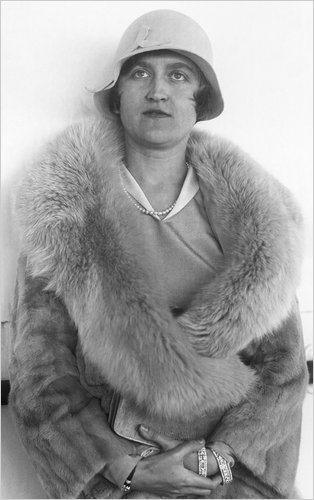
Last known photo taken of Ms. Clark | 1930
Almost a month ago, I posed a question to you dear Chiclets: don't we think that the life and death of zillionaire copper heiress Huguette Clark would make a great opera? You'll remember that Ms. Clark died last month - just shy of her 105th birthday - surrounded by many of her beloved dolls and the nurse that had been hired to care for her at the New York Hospital - where she was registered under an alias.

One of two daughters born to Senator and copper baron William Andrews Clark and his second wife Anna Eugenia LaChappelle, Ms. Clark was the only surviving immediate family member of the Senator as Ms. Clark's sister Louise A. A. Clark (called Andrée) died when Ms. Clark was 16.

Ms. Clark's story - from beginning to end - is more fascinating that I can even describe. Someone needs to make this into some sort of book-screenplay-movie situation, pronto. Please. Oh, PLEASE!

When Ms. Clark was a child, her father was described as either the richest or second-richest American, neck and neck with John D. Rockefeller. Senator Clark made his fortune in copper mining in Montana and Arizona, and owned banks, railroads, newspapers, saw mills, real estate and many other investments. He served one full term in the Senate as a Democrat from Montana, from 1901 to 1907, despite having to give up the seat earlier in 1900. The scandal that cost him his seat involved bribes paid to legislators so that they would send him to the Senate - back when the legislators decided senators. It is my understanding that Senator Clark defended himself by saying: "I never bought a man who wasn't for sale." (Who hasn't heard that phrase before?)

And, PS ... The 17th Amendment to the U.S. Constitution, which removed the election of senators from the hands of legislators and gave it to the people, seems to be an ambiguous tribute to his legacy.

While serving in the Senate, the 65 year old who was widowed after his first wife Katherine Stauffer died, shocked the political and financial world by announcing that he had secretly remarried three years earlier. Not only that, but he and his 26-year-old wife already had a 2 year old daughter, Louise (Andrée). A second daughter, Huguette, was born in 1906.

A teenage Huguette Clark in the 1920s.
Can you only imagine what would happen in 2011 if a 65 year old senator came forth and said, "Oh, by the way ... I've been married for 3 years to a woman in France. And, we have a 2 year old daughter." Scandal! Now, imagine what that must have been like 107 years ago. Mind-blowing.

When little Huguette was 4-ish, the family of four moved into a 121-room house at Fifth Avenue and 77th Street in New York City. In his later years, Senator Clark developed a passion for collecting art and their huge-tastic house was packed to the gills with his collection. In fact, to better be able to negotiate for coveted pieces, he learned to speak fluent French and German.

Fast forward to 1925 - Senator Clark died and soon was largely forgotten. But, in Montana and Arizona the stories of Senator Clark live on - after all, it was his railroad that spawned the city of Las Vegas and Clark County is named for him. Also, his vast art collection is largely responsible for the establishment of the Corcoran Gallery in Washington, DC where his heirs donated most of his collection. (The Corcoran Gallery makes a comeback in the story, later.)

Ms Clark was 19 years old when her father died and at that time, she and her mother moved to the penthouse at 907 Fifth Avenue. In addition to living with her mother, Huguette Clark was well taken care of, financially speaking. She received an allowance of $7,500 a month (that would be about $100,000 a month in today's dollars), and when she reached 21 she inherited one-fifth of her father's estate. This was an even split with his children from his first marriage to Katherine. The entire estate was estimated at up to $300 million, or about $3.6 billion in today's dollars.

This little tidbit of knowledge changes some of my perceptions of Ms. Clark's fortune. You see when I hear in the media "heiress to the Clark copper fortune", I think that she is the sole heir to the entire fortune. Well, now we see that is not true at all as the good senator's fortune was fairly divided among all of his living children.

During her life, Huguette Clark managed to take the roughly $60 million that she inherited - again, her piece of the Clark fortune - and increased it to include at the time of her death, $400 million, priceless works of art, a massive doll collection comprised of both French and Japanese dolls, numerous musical instruments and Real Estate holdings that include two estates and two apartments at 907 Fifth Avenue in New York. One of the apartments at 907 Fifth, reportedly the largest apartment on the island of Manhattan, takes up the entire 12th floor of the building (seen here). While the other apartment, which was where Huguette's mother Anna lived, takes up over half of the 8th floor.

It would seem that Ms. Clark came from family of "collectors". Her father collected art as she did also. And then, there was her half-sibling, William Andrews Clark, Jr., who settled in Southern California. The Junior Mr. Clark had a prominent collection of Oscar Wilde memorabilia and used his powerful fortune to influence the arts as well - he founded the Los Angeles Philharmonic in 1919. Brother Clark Jr. died in 1934 when Ms. Clark was only 28 years old and was entombed at the Hollywood Forever Cemetery in a large mausoleum that sort of resembles The Parthenon. His story is pretty dramatic as well - you can check it out here.

So, who stands to inherit Huguette Clark's fortune? What about her "next of kin"?

907 Fifth Avenue
Our waiting and wondering is now over. On Wednesday, Huguette Clark's Last Will & Testament was filed and released to the public. Let's just say this - she didn't mince words:
I intentionally make no provision in this my Last Will Testament for any members of my family, whether on my paternal or maternal side, having had minimal contacts with them over the years. The persons and institutions named herein as beneficiaries of my Estate are the true objects of my bounty.
Wow. She didn't just leave them out of the Will - she cut. them. out.

That means that the thirteen half-grandnieces and half-grandnephews as well as the eight half-great-grandnieces and half-great-grandnephews, all descendants of Senator Clark and his first wife, Katherine, will not receive one single penny of her fortune. But, let's be honest - it's not really theirs to get. After all, when Senator Clark died, his money was divided up evenly among all of the surviving children from both marriages. In a sense, they got theirs and this Estate truly is Huguette Clark's fortune. It would appear, though, that they are set to contest the Will - which is why Wallace Bock (Ms. Clark's Attorney) has filed a Citation with the Surrogate's Court requesting that they all show Cause - by August 17th.

So - where is all of that fortune set to go? I thought you'd never ask. According to the Will - which I've poured over myself ... and you know it's true - Ms. Clark’s "loyal nurse, friend and companion Hadassah Peri", is the individual who will benefit most. Ms. Peri will receive 60 percent of Ms. Clark's total estate, worth about $33 million, including investments and much of Ms. Clark's real estate holdings - that is to say, those not specifically bequeathed in the Will. Ms. Clark’s goddaughter, Wanda Styka, will get 25 percent of the Estate.

The will, which is dated April 19, 2005, leaves $1 million to Beth Israel Medical Center, where she lived for the final 20 years of her life, even while in good health, and where she died; $500,000 to her assistant; and $100,000 to a physician. An original of Claude Monet’s Water Lilies — which hasn't been seen in public for more than eighty years — has been gifted to the Corcoran Gallery of Art in Washington D.C..

Perhaps the most notable (and hotly contested) provisions in the Will are those that leave $500,000 each to Wallace Bock (Ms. Clark's attorney) and to her accountant, and known felon, Irving H. Kamsler. An investigation is currently under way to determine whether or not Bock and Kamsler acted in Ms. Clark's best interest.

Huguette Clark's Bellosguardo | Santa Barbara, CA
No one ever understood what Huguette Clark "did" for a living. By that, I mean what her occupation was. Interestingly enough, in the occupation section of her death certificate, Ms. Clark is listed as "Artist". Which brings me to the final chunk of Ms. Clark's estate which is set out to benefit what was near to her heart - the arts. From Ms. Clark's Will:
I direct my Executors hereafter named to form a private foundation ... to be named "Bellosguardo Foundation" and take all necessary steps to organize, operated and qualify said foundation as an educational organization ... for the primary purpose of fostering and promoting the arts.

I give, devise and bequeath to said Bellosguardo Foundation, my real estate in Santa Barbara, California at 1407 East Cabrillo Boulevard, known as Bellosguardo and all of the personal property contained therein or used in connection therewith ... as well as all of my works of art [Except the Water Lillies], musical instruments, rare books and library contained in my apartments at 907 Fifth Avenue, New York, New York and policies of insurance covering same.
This means that not only will the Bellosguardo Foundation be focused on the arts, and it will begin with approximately $8 million, and will possess all of Ms. Clarks rare belongings, as well as her Bellosguardo estate - a 21,000-square-foot mansion on a 24-acre oceanfront property in Santa Barbara.

I say: good for you, Ms. Clark. Let's hope your "family" doesn't keep your Estate held up in the courts and that your wishes will be carried out in short order.

I continue to remain utterly fascinated by this story. For more, visit clark.msnbc.com.

Wednesday, June 22, 2011

Mezzo soprano Joyce DiDonato discusses Kansas and the arts ... or, lack thereof

You don't have to look very far to see that the arts in this country are suffering. Many opera companies and orchestras are drying up - so much so, in fact, that I used to keep a running list in the side bar of companies that were closing their doors. However, the list became too large.

Recently, many of us groaned in absolute disgust when we heard that the state of Kansas, in all of it's "wisdom", completely slashed the arts out of the state budget. Well, my Chickpeas... mezzo soprano Joyce DiDonato, a native Kansan, isn't taking it lightly.

From the Kansas City Star:
A future without limits begins with valuing art

By JOYCE DiDONATO
Special to The Star

With one, autonomous slash of the pen, every state penny for the arts in my home of Kansas has vanished, simultaneously obliterating all matching federal funds.

This is the Sunflower State that I have proudly boasted about across the world, fearlessly defending it even in the face of harsh quizzical looks from the most skeptical of folks (“You live where?”). It’s the state of my first piano recital and choir concert. The home field of my artistic curiosity and education. The homeland that taught me to freely dream big and without limitation; one where the arts were once alive, vibrant and supported.

I’ve welcomed the assumption of being an unsolicited but mightily proud artistic ambassador for Kansas to the great cities of the world. Now, for the first time, I feel shame. Eliminating a state arts commission is an ignorant, short-sighted, fearful and unspeakably damaging act to the spirit and soul of this great state.

I’m not a politician or historian. I’m a humble opera singer, a home-grown product of an agricultural state that used to value the arts, like all great societies and cultures of the past. But my anger rivals a good ol’ western Kansas Category 5 tornado’s destructive force when I begin to think of where I’d be without an education fueled by the arts that informed my way of thinking. Or without a community theater, choir or art exhibit that gave me true solace and an emergency exit from some of the great crises in my life. Or without that musical outlet that helped me understand myself and the mystery of life a little better.

“But what merit is there in that? You can’t test it. You can’t put a value on it. Must not count for much,” critics seem to imply.

So let’s talk finances: that almighty, motivating dollar. Alex Aldrich, head of the Vermont Arts Council and the man the governor used as an example of why this cut was “good,” argues: “Finally, and perhaps most importantly, every state should invest in the arts sector simply because it makes good economic sense. One of our most conservative policy analysts looked at state and local tax revenues that flowed to state and municipal coffers from our very narrowly-defined arts sector in Vermont. Income taxes paid by artists, arts administrators and independent arts contractors reveal a total return of $19.45 million on a combined investment of $2.5 million, which includes our $500,000 (state) appropriation. This annual return on investment of 775 percent is even more astonishing since virtually all of Vermont’s state tourism dollars promote skiing, outdoor recreation, fall foliage, maple syrup, and artisanal food preparation and service, not art and culture — a circumstance which, I am happy to say, is going to change starting this summer.”

Leaving aside any cultural, artistic argument, it is simply bad business. Loss of tax revenue, loss of jobs, loss of neighborhood traffic and business should be reason enough to reinstate funding to the arts in Kansas.

President Kennedy said, “I look forward to an America which will reward achievement in the arts as we reward achievement in business or statecraft.

I look forward to an America which will steadily raise the standards of artistic accomplishment and which will steadily enlarge cultural opportunities for all of our citizens. And I look forward to an America which commands respect throughout the world not only for its strength but for its civilization as well.”

We unquestionably need the support of the state of Kansas for the arts; financially as well as culturally.

Joyce DiDonato of Kansas City is an international opera star and a Prairie Village native. She has performed in top international concert and opera houses and is the winner of many honors, including the Beverly Sills Award from the Metropolitan Opera, the Echo Klassics 2010 Female Singer of the Year and the 2010 Gramophone Artist of the Year.
Thank you, Miss Joyce!

Make sure to follow Joyce DiDonato on Twitter @JoyceDiDonato.

Friday, June 17, 2011

NY City Opera: The dust-up continues

Sometimes, you just have to shut your trap and let others do the talking ... or writing. To that end, I bring you some recent highlights regarding City Opera
Why City Opera May Bite the Dust, and What That Means for New York
Zachary Woolfe for The New York Observer

Looking back, it should have been clear in October how New York City Opera’s year was going to end.

The company opened its season then with the New York premiere of A Quiet Place, the strange, flawed, fascinating final opera by Leonard Bernstein, one of the city’s favorite sons. The opera is close to the heart of City Opera’s artistic director, George Steel, and it felt, in the lead-up, like an “event.” The company treated it as such: in Christopher Alden’s thoughtful production the work received the best possible presentation, and the orchestra sounded great under the young conductor Jayce Ogren. The reviews—it was covered everywhere—were good.

No one came...

...This is as delicate a moment as any in a cultural institution’s history. George Steel, who has never had to cultivate donors on this scale, will have to call on all of his considerable talent, charisma and vision to convince people to take a chance, something most people are unwilling to do with large quantities of their money during a recession. (Mr. Steel is still stuck with much of the board responsible for the mismanagement. Ex-chairman Susan Baker, I’m looking at you.)

But Mr. Steel’s best may not be enough. The company could sell out 500-seat theaters and get raves in every paper and still not convince people to give it the kind of support that could ensure its future. In that case, New York, like Minneapolis, will be a one-opera town.
Beverly Sills in "Manon"
City Opera 1969 / Beth Bergman
Furthermore ... there's this:
How People’s Opera Orchestrated Its Peril
Robin Pogrebin and Daniel J. Wakin for The New York Times

AT first glance New York City Opera would appear to have been blessed with a full chorus of advantages.

For 46 years it was a fixture at Lincoln Center, operating at the city’s premier cultural hub in an elegant theater overlooking the plaza fountain. Most of its utility expenses were paid by the city, which owns the building.

It split other expenses with the New York City Ballet, which shares the space. And when the opera sought a renovation, a generous donor and the city stepped forward with $125 million to pay for it.

But now, less than two years after that expensive makeover, City Opera is homeless. Last month the company announced that it is leaving Lincoln Center for stages unknown because it can no longer afford to operate there...

...“City Opera’s programming failed to engage its audience because it was dark for a season and then came back with esoteric choices that didn’t suit the people’s opera,” said Joseph Volpe, the former general manager of the Metropolitan Opera. “If you can’t sell tickets, you can’t raise money.”...

...Still, Mr. Steel said he is not worried. “I hope to be known as the general manager who found a new stable footing for City Opera,” he said.

The move, he said, frees City Opera from the “the cultural gigantism that created Lincoln Center” and the pressure to do big works to fill the house. “The new model is both financially stable and artistically liberating,” he said. “It’s an incredibly exciting prospect.”...

...But many opera veterans are skeptical.

“I have loved City Opera since the late ’50s, and it makes me very sad to see it in such a terrible state,” said Speight Jenkins, the general director of Seattle Opera. “I don’t frankly understand how you can perform in several locations and keep your subscriptions.”
And then, last night I received the following letter in my email inbox - copied as received with certain text in bold:
Dear Friend,

I am pleased to update you on City Opera's progress in preparing its 2011-2012 season, which will include an intriguing mix of new and classic works, each showcasing today's finest young singers.

Our goal in planning the season has been unique and precise: to find the perfect venue for each opera we do. As you know, New York City is incredibly rich in theaters and performing spaces, and we couldn't be more pleased with the exciting new partnerships we are now finalizing. I believe that the 2011-2012 season will be the start of an inspiring new era of civic engagement for City Opera, as we re-imagine our founding mandate to be the "people's opera."

Another piece of good news is the tremendous success of our Chairman's Challenge fundraising campaign. Since this effort was launched in May, City Opera has raised a remarkable $2.1 million, making it one of the company's most successful fundraising initiatives to date. Many of you have already responded to Chairman Charles R. Wall's call-to-action, and for that, all of us at City Opera join in a chorus of thanks and gratitude. Thank you!

For those of you who have yet to respond, there is still time to make your voice heard. Visit nycOpera.com/challenge or call 212.870.4210 to make your gift today.

Many people ask me how City Opera can take on so much change in such short order. My answer is this: for more than 67 years, City Opera has proven itself to be a company that makes the seemingly "impossible" possible - whether it's putting American opera on the map, being the first to introduce supertitles, or simply making opera accessible to a broad audience.

I promise that with your support, City Opera's 2011-2012 season will be the start of an exciting new chapter in the company's remarkable history. City Opera has always responded to challenges with imagination, ingenuity, and unstoppable passion for the art form which we all love, and today is no exception. I look forward to sharing the good news about the upcoming season with you very soon.

Thank you for your interest, generosity, and patience.

With gratitude,

George Steel
General Manager and Artistic Director
Like sands through the hourglass ... ...

Tuesday, June 14, 2011

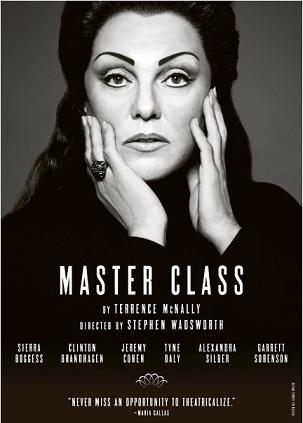
Manhattan Theater Club presents "Master Class"

Way back in January of 2010, I asked the question: Tyne Dale as Maria Callas?.

Then, earlier this year we heard directly from Tony Award-winning playwright and librettist Terrence McNally on the revival of his play Master Class - starring Tyne Daly. And now...
Tyne Daly's late-career diva Maria Callas in Terrence McNally's music-kissed biographical drama, Master Class, dawns on Broadway starting June 14 at Manhattan Theatre Club's Samuel J. Friedman Theatre. The play about the famed opera star won the 1996 Tony Award as Best Play.

Director Stephen Wadsworth worked with Tony Award winner Daly (the 1989-90
Gypsy) on the 2010 Kennedy Center revival of McNally's play, set in a master class in which Callas critiques young legit singers and muses on her life, loves and career. Wadsworth's Broadway company includes Olivier Award nominee Sierra Boggess (Love Never Dies, The Little Mermaid) as student-singer Sharon, a role that won Audra McDonald a Tony Award; Clinton Brandhagen as a Stagehand; Jeremy Cohen as accompanist Manny; Alexandra Silber as student-singer Sophie; and Garrett Sorenson as student-singer Tony.

This MTC limited engagement opens July 7 and is on sale through Aug. 14.

According to MTC, "Terrence McNally's play about Maria Callas (Tyne Daly) takes us to one of her famous master classes, where, late in her own career, she dares the next generation to make the same sacrifices and rise to the same heights that made her the most celebrated, the most reviled and the most controversial singer of her time." [Source]

Monday, June 13, 2011

Absolutely Agog: "Oh! Hope. Blood and Turandot!"

I'm not exaggerating this, Friendlies... the moment I found out that soprano Christine Brewer was going to be debuting at the Hollywood Bowl singing none other than Puccini's Turandot, I went bananas. I posted on Twitter. I posted on Facebook. I sent out text messages. Basically, the only thing I didn't do was open my 11th floor window and shout down to the street level (although, let's be honest ... we all know I contemplated it).

That's right! On July 17 at the hallowed Hollywood Bowl, Brewer sings the title role of Turandot in a concert performance with the Los Angeles Philharmonic under Maestro Gustavo "Wunderkind" Dudamel. The performance marks the first time Brewer - who, according to the San Francisco Classical Voice, has a phenomenally outsized instrument marked by lustrous tone, rich coloration, and laser-like precision - will have sung Puccini’s Chinese princess. It also marks Dudamel’s first time conducting a Puccini opera.

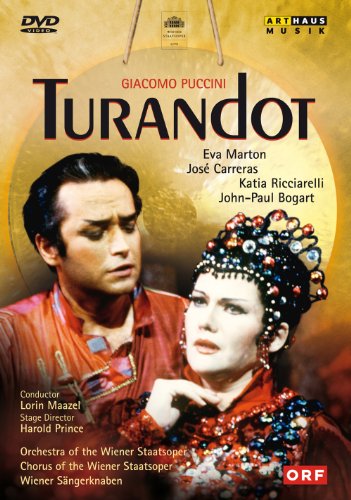
All of this talk put me in the mood for my favorite Puccini. And, it just so happens that I had one in my back pocket waiting for a little spin through the DVD player. It heralds from a 1983 Vienna Statsoper production conducted by Lorin Maazel with Hungarian soprano Eva Marton as Turandot, Jose Carreras as Calaf and Katia Ricciarelli as Liu.

Last Thursday, I was home with my 6 1/2 year old daughter who had a day off from school. I thought to myself: I'll throw in this little thing and see what she thinks about it. She's about as obsessed as I am. She read every single subtitle out-loud as though she were doing a reading for the casting agents of Annie. Later that evening after her mother got home, I asked "Hey - I have a question: What were the answers to Turandot's three riddles?" [Spoiler Alert!] Without hesitation, she replied "Oh! Hope. Blood and Turandot!" She then proceeded to recount the entire plot to her mom. No. Joke. The girl then chose this very DVD of Turandot to be the Feature Presentation of our weekly "Movie Night" the following evening.

If you plan to watch, and clearly you should plan to watch, be warned - the production is stereotypically operatic. That is to say that those who have become accustomed to the newer HD Broadcasts will see more "park and bark" than they're probably used to. Additionally, movements are theatrical in nature so, they seem a little more exaggerated on TV than they would in the theater.

In this production, a 37 year old Jose Carreras delivers a helluvah Calaf - his voice strong and well matched to Marton's Turandot... not an easy feat by any means.

It takes a very specialized voice to sing Turandot and Marton, who made her career singing the role, had it - although she looks like she's working pretty hard in a couple of places. Who am I to judge, though? Turandot appears and the first thing out of her mouth is the unforgiving aria "In questa reggia" ... followed by launching herself into the operatic stratosphere to sing the 3 riddles. I can forgive a little look of difficulty.

Katia Ricciarelli disappoints as Liu. I've never really been a fan of her voice. In fact, if it were up to me to give her a Native American inspired name, it would be: soprano-always-sings-flat.

I do heartily recommend this DVD version of Puccini's final opera. Not only is it old-school-Puccini through and through - but, the translations are quite good ... especially when read by a 6 1/2 year old. ;-)

If you happen to be looking for a Turandot that has a cast of currently working singers or one that is perhaps in HD, I would tell you that take a gander at the Zeffirelli production featuring Maria Guleghina as the Ice Princess and Marcello Giordani as Calaf. Patrick Mack wrote for parterre.com:
In what may qualify as the most unholy alliance of Peter Gelb‘s tenure at the Met so far, since February the “Live in HD” performances from 2009 of both Turandot and Aida issued by Decca have been available from… Target. Only Target. They are scheduled for international release this July. Up until recently there has been no mention on Decca’s or The Met’s website of either. It’s like the first Mrs. Rochester hidden away. Also, they’re both a bargain at $19.99 a piece...

...First, I have to confess that I worship this Zeffirelli production of Turandot. It’s nouveau riche tacky like a lottery winner. It’s Vegas. Florenz Ziegfeld would have wept. To the uninitiated among us a production like this can inspire a cataclysmic, religious conversion to the art form. It is Oz. The act two set change is captured here perfectly. The camera pulls back from Ping, Pang and Pong departing their abode into the darkened theater so that when the lights come up on the palace and the populace you get it right between the eyes with both barrels. I was verklempt. This DVD is opera porn.

Friday, June 10, 2011

It's beginning to look a lot like TONY TIME - The 2011 Tony Awards

Has it been a year already? A *year* since Hollywood trotted out a bunch of out-of-work stars and called it the Tony Awards?

Indeed. It's that time again, Chickpeas... TONY TIME! The Antoinette Perry "Tony" Awards will be broadcast live, from the Beacon Theatre on CBS, Sunday, June 12th, 8:00 - 11:00 p.m. (Sorry for the time delay PDT'ers).

So - now, for a little teaser ...

On Wednesday, the Tony Awards announced the line-up of performances for the telecast. Featuring unforgettable opening and closing numbers and non-stop entertainment throughout the entirety of the show - the evening will include performances by the 2011 Tony-nominated Best Musicals, Anything Goes featuring Sutton Foster; Catch Me If You Can with Norbert Leo Butz and Aaron Tveit; How to Suceed in Business Without Really Trying featuring Daniel Radcliffe and John Larroquette; Sister Act featuring Patina Miller; The Book of Mormon featuring Andrew Rannells and The Scottsboro Boys featuring Joshua Henry.

Additionally, casts from some of Broadway's "other shows", will take the stage - including the 2010 Tony Award Winning Musical Memphis; Spider-Man Turn Off the Dark featuring Reeve Carney and Jennifer Damiano; John Leguizamo's Ghetto Klown; and the cast of Priscilla Queen of the Desert featuring Nick Adams, Tony Sheldon, Will Swenson and special appearances by Paul Shaffer and the legendary Martha Wash.

As previously announced, the Tony Awards will reassemble an all-star cast of the New York Philharmonic's April 2011 limited run of Company. This once-in-a-lifetime assembly of talent will perform LIVE exclusively at the Tony Awards and will feature Stephen Colbert, Jon Cryer, Katie Finneran, Neil Patrick Harris, Christina Hendricks, Aaron Lazar, Patti LuPone, Jill Paice, Martha Plimpton, Anika Noni Rose, Jennifer Laura Thompson, Jim Walton and Chryssie Whitehead.

Hosted by Emmy winner Neil Patrick Harris, the evening will feature appearances by: Alec Baldwin, Christie Brinkley, Matthew Broderick, Harry Connick, Jr., Viola Davis, Whoopi Goldberg, Kelsey Grammer, Joel Grey, Marg Helgenberger, Samuel L. Jackson, James Earl Jones, Angela Lansbury, Jim Parsons, David Hyde Pierce, Daniel Radcliffe, Vanessa Redgrave, Chris Rock, Brooke Shields, Robin Williams, Patrick Wilson and Catherine Zeta-Jones.

Even though I don't see my favorite red head Kathy Griffin on the above lists, I'm still looking forward with cautious optimism.

Make sure to follow the Tony Awards on Twitter - as well as on Facebook.

Wednesday, June 8, 2011

NY City Opera: An open letter to Mayor Michael Bloomberg from MusicalAmerica

Yesterday, we had an Op/Ed from NY City Opera's former Maestro and General Director, Julius Rudel. Today, it appears that another has hopped on the "Save City Opera ... from itself" bandwagon - this latest plea comes from MusicalAmerica.com's George Loomis:
NEW YORK -- As bleak news continues to pour out of the New York City Opera, it is painfully obvious that only extraordinary action will allow the company as we know it to continue existing. Perhaps the person best positioned to trigger such action is the mayor of New York, Michael Bloomberg. Accordingly, the following is directed to him.

Dear Mayor Bloomberg:

In the 1940s Mayor Fiorello La Guardia played an essential role in creating the New York City Opera. He found it a home and helped establish its reputation as the “people’s opera.”

Now the New York City Opera is on the path to ruin. Without your intervention, without new, competent management, the company is doomed to failure, and Mayor La Guardia’s pledge to New Yorkers will be rendered hollow.

The dreary record of current and recent mismanagement includes

• Engaging a famous European impresario as general manager on unrealistic terms, with devastating consequences when he exercised contractual rights not to assume the job.

• Renovating the theater in a long process during which the company had no performance venue yet still had contractual obligations to union members. The company’s roster of singers was effectively disbanded.

• Shrinking the endowment from $55 million to $9 million.

• Announcing last month that the City Opera would leave Lincoln Center. Leaving the overly large venue formerly known as the New York State Theater for a smaller, more opera-appropriate space has long been a dream of many New York opera fans -- but never under the dismal circumstances of a destitute company uncertain of where its next home will be.

• Hiring as general manager George Steel, a man with negligible operatic experience, except for three months heading the Dallas Opera immediately prior to his appointment. Under Steel, who was paid over $400,000 in salary and benefits in 2009, the number of performances by the company has been drastically curtailed.

There are people out there who actually know how to run opera companies. Steel is not one of them. His offbeat programming has won some critical favor, as with the triple bill called
Monodramas. But—come on!—how many people really want to sit through 45 minutes of Morton Feldman? Small wonder box office receipts have been dismal.

The City Opera is too important for New York to lose. And one need not look back to the days of Beverly Sills to find an artistically vibrant company. As recently as the 2006-07 season, under Paul Kellogg’s leadership, the company was in good shape and gave six performances a week.

This reminds us that the City Opera’s current difficulties stem not from a proven inability to function economically—though running it has never been easy—but from missteps by management.

A few days ago Bloomberg, the news company that bears your name, urged that Joseph Volpe take over the City Opera. The former Metropolitan Opera general manager is exactly the kind of strong personality needed.

I am not asking for a bailout by the City, although some financial support may well be inevitable. What is required is for you to get involved. First, Volpe or someone of comparable stature needs to be engaged. With such a leader in the wings plus a strong commitment by you, the health of the company – and of its image to donors -- would improve markedly.

Also with your help, it would be possible to identify a select group of major donors who, coupled with assistance from the City, could see the company through this difficult time until it gets back on its feet. People currently in power must be persuaded to go quietly.

Lincoln Center, too, should take a major role in saving the City Opera from failing, perhaps with a takeover analogous to the Kennedy Center’s takeover of the Washington National Opera.

Without such radical changes, the City Opera as we know it is doomed. New Yorkers will not back a loser.

Last week the company announced that it would let go of 11 of its 48 administrative employees. But it would be getting rid of the wrong people. Those in power, including Steel, are the ones who should go, plus board members unwilling to provide truly substantial financial support under a new leader.

New York’s artistic reputation is at stake. For the good of the city, I urge you to follow Major La Guardia’s model of active involvement.

Yours sincerely
George Loomis,
MusicalAmerica.com
So ... who's up next?

Tuesday, June 7, 2011

NY City Opera: An Op/Ed from it's former Maestro - Julius Rudel

Quite a hoopla has been made of the recent decision by New York City Opera management and board to leave Lincoln Center ... thus, beginning a rootless existence -- roaming the New York Cityscape in search of performance venues.

Those of us who find ourselves scanning the 'net in search of the latest morsel of information on the matter were given not just a morsel ... but instead, we were thrown a nice juicy bone to chew on.

Very early this morning (or was it very late last night?), I noticed an Op/Ed piece on The New York Times website titled: Preserving New York City Opera. This Op/Ed was penned by none other than NY City Opera's former general director and principal conductor, Maestro Julius Rudel.

Let's be honest, Chiclets ... I would be negligent if I did not bring it to you in it's entirety. Right? (Many thanks, in advance, to The New York Times):
Preserving New York City Opera
By JULIUS RUDEL
Published: June 07, 2011

The New York City Opera was born in 1943, a year after I graduated from the Mannes Music School. Laszlo Halasz, the company's first music director, hired me as a rehearsal pianist and vocal coach. I was 22 and had arrived in the United States five years earlier, after Hitler took over my native Austria.

That an opera company could be created while World War II raged spoke to America's best aspirations. Mayor Fiorello H. La Guardia called it "the people's opera," in contrast to the older Metropolitan Opera, and from the beginning, it was. It brought opera to the masses, including immigrants like myself. It exposed audiences to innovative and challenging works. It showcased the talents of American singers and composers.

Today, City Opera, to which I devoted some of the best years of my conducting career, is fighting to survive. Last month, it revealed plans to leave Lincoln Center, its home for the last 45 years, and to perform at various, unspecified locations around New York. It slashed its $31 million budget and laid off nearly a quarter of its administrative staff members. And it declined to say what operas it will put on next season, where they will be performed or how they will be financed. The vague plans put forward would leave the company not even a shadow of what it was intended to be - and became.

Some have blamed the company's woes on its Lincoln Center location, citing the expense and the proximity to the Met. But I believe the location has become a scapegoat for the hardships of a company that has suffered from inconsistent leadership by its board and a failure to engage in the smart programming and strategic planning that companies need to survive in hard times. I cannot sit by and watch as the legacy that was built by a company, if not a family, of talented, dedicated people is cast aside.

In 1965, when we considered moving from our first home (New York City Center, on West 56th Street) to the New York State Theater (now the David H. Koch Theater) at Lincoln Center, I was apprehensive, fearing that we might be forced to abandon the qualities that had allowed us to grow. I was wrong.

From our first night in our new home - Feb. 22, 1966, the North American premiere of Alberto Ginastera's
Don Rodrigo, starring a 25-year-old Plácido Domingo - the benefits were apparent: the ambience, the proximity to other institutions (including, yes, the Met), and the attention the international music press lavished on the new arts complex. That attention helped us to attract, despite our low fees, top-flight singers, conductors and directors.

The new space and new technologies also allowed us to put on memorable productions of Arrigo Boito's
Mefistofele, Leos Janacek's Makropulos Case and Erich Wolfgang Korngold's Tote Stadt, among others. We presented new works and reinterpreted old ones to sold-out houses. At its peak, we presented 200 performances a year in New York and undertook annual tours to Los Angeles and Washington.

We also developed teams of ensemble singers, many of whom went on to major international careers - Beverly Sills, Norman Treigle, Phyllis Curtin, Beverly Wolff, Samuel Ramey, Catherine Malfitano and many, many others - and helped establish the American opera singer as a force to be reckoned with. If we had become the traveling band that is currently being proposed, many of those careers might never have blossomed.

Indeed, Lincoln Center solidified the company's place not as New York's second opera company, but as New York's other opera company. We were never thought of, and never thought of ourselves, as a lesser Met.

Over 68 years, I have seen City Opera thrive and I've seen it struggle. I realize that today's economic climate and changing paradigms in the arts pose monumental challenges. Opera companies everywhere face the question of how to attract and retain audiences; keeping the opera experience fresh and meaningful, making certain that what is presented is first-class, and experimenting with innovative repertory and productions that steadily build audiences are vital to assure opera's survival.

Once before, in 1956, City Opera faced the threat of bankruptcy, but instead of retrenching and cutting, the board boldly moved forward, securing the financing we needed to stabilize the company and then grow. The current board must reconsider its decision and demonstrate the commitment and vision its predecessors had.

If the board and management of City Opera cannot finance, produce and support full seasons of new works and standard operas in interesting productions with first-rate casts as we once did, they should be replaced, so that 68 years from now no one will wonder what ever became of City Opera.

Julius Rudel was the general director and principal conductor of the New York City Opera from 1957 to 1979.
Julius Rudel, FTW!

It kind of makes me wonder - what would Beverly Sills say right about now?

Wednesday, June 1, 2011

"It's the day of the show, y'all..." American Masters presents - James Levine: America's Maestro

Tonight's the night, Ladies and Gents.

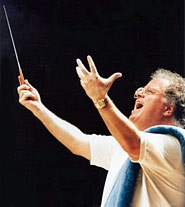
To celebrate Maestro James Levine’s 40 years at the Metropolitan Opera, PBS' American Masters series presents James Levine: America’s Maestro - premiering nationally tonight at 8PM (check your local listings to confirm).

As part of its 25th anniversary season, American Masters explores the conductor’s life and current work - capturing the essence of one of classical music’s authentic giants. Looking back at creative milestones since his 1971 Met debut with Tosca at the age of 28, the film reveals how Levine’s unparalleled musicianship and singular teaching and performance styles make his relationship with the company unique in today’s music world. This one-hour documentary film - directed by Susan Froemke and executive produced by none other than Peter Gelb - provides an insider's view into how Levine transformed The Metropolitan Opera’s Orchestra into one of the great ensembles, elicited legendary performances from leading singers and nurtured new generations of artists.

I seriously can't wait! I love a good biographical documentary.

For more, visit pbs.org.

Incidentally, much ado has been made about James Levine's health and his stamina as Music Director of the Met. So much so, in fact, that many have speculated (and some have even made claims to the fact) that current principal guest conductor Fabio Luisi is the heir-apparent to Maestro Levine's throne.

Not so, says Luisi - at least according to Norman Lebrecht's blog:
Fabio Luisi, touring Japan with the Metropolitan Opera, has taken issue with Peter Gelb’s suggestion that he is the logical successor to James Levine. ‘He said nothing about it to me,’ laughs Luisi. ‘I said to my wife, look what’s in the paper…’

In an interview today with the Tages-Anzeiger of Zurich, he says that he’s agreed to be principal guest conductor at the Met, which means leading one or two productions a year. His main job, from next year, will be music director of the Zurich Opera, and that will keep him busy.

Luisi spoke warmly of his 15-year connection to the new Zurich intendant, Andreas Homoki, and the plans they have together. He is also chief conductor of the Vienna Symphony Orchestra, the city where he mostly lives.

I wrote at the time that Gelb was using him as a decoy; Luisi, a straightforward man, confirms today that he was misused.
We'll bring you more information as it becomes available. You know it's true.

In Memoriam: Giorgio Tozzi 1923-2011

Tozzi as Ramfis in Aida
Star of Broadway, TV and one of opera's greatest un-sung heroes has passed away. Bass Giorgio Tozzi has died at the age of 88. Fred Plotkin of WQXR writes in part:
As the news of death of the great bass Giorgio Tozzi has begun to spread, a few people have asked me, “Where in Italy was he from?” The answer was Chicago. Tozzi was born in the same year as New Yorker Maria Callas, another artist to whom many European opera lovers have assigned a continental birth certificate. Both were Americans of immigrant background, just like President Obama. Tozzi's was an American story but, as with all of the greatest singers, he belonged to all of Planet Opera.
While F. Paul Driscoll writes for OperaNews:
A stimulating, versatile artist of peerless imagination, bass Giorgio Tozzi, one of the most admired — and most beloved — artists on the Met roster for twenty-one seasons, has died. He was eighty-eight.

Beginning with his company debut, as Alvise in
La Gioconda, in 1955, Tozzi sang thirty-eight roles in his 528 Met performances. Tozzi's Met assignments ranged from Don Basilio and Mozart's Figaro to Sparafucile, Filippo II and Boris Godunov; whether his vehicle was comic or tragic, Tozzi created characterizations that were models of elegance and concision, performances as remarkable for their dramatic conviction as for their vocal beauty. He was one of the Met's most valuable players, deployed in eleven new productions for the company during his time with them ...

... A cheerful, unfailingly positive colleague, Tozzi managed to stay above opera-house politics, remaining on good terms with his fellow basses and with Rudolf Bing, the Met's formidable general manager, for most of Tozzi's career in the house. Tozzi's relationship with Bing survived the bass's refusal of the role of Enobarbus in the world premiere of Samuel Barber's
Antony and Cleopatra, the opera that inaugurated the Met's Lincoln Center home in 1966; when Tozzi turned down the Barber premiere — in a 2002 OPERA NEWS interview with Martin Bernheimer, Tozzi allowed that he was not eager to spend time learning an opera that might not last long in the repertory — Bing offered the bass his choice of new roles in the company's first Lincoln Center season. Tozzi chose Hans Sachs, which became one of his favorite assignments; his masterful characterization of the cobbler-poet is preserved in Joachim Hess's 1971 film of Leopold Lindtberg's Hamburg Staatsoper production.

Tozzi made his Broadway debut (as George Tozzi) in 1948, as Tarquinius in
The Rape of Lucretia. The following year, he appeared in London's West End in the musical Tough at the Top, playing a boxer who falls in love with a princess. He returned to Broadway in 1979, as Tony in a revival of The Most Happy Fella, which won him a Tony Award nomination. Tozzi also starred as Emile DeBecque in several South Pacific productions — he provided the soundtrack vocals for Rossano Brazzi's DeBecque in the 1958 film — as well as in regional and stock stagings of Fiddler on the Roof, The Great Waltz, Fanny, Music in the Air and Man of La Mancha.

Tozzi's warmth and persuasive charm made him a natural on television. In addition to solo turns on The Ed Sullivan Show, The Bell Telephone Hour and other variety programs, Tozzi was a memorably vulnerable Boris Godunov (in English) in the 1961 NBC Opera Company production of Mussorgsky's opera and a dignified King Melchior in NBC's 1978 television film of
Amahl and the Night Visitors. A vivid actor even without a score to support him, Tozzi appeared in non-singing roles on The Odd Couple, Kojack and other television series, as well as the 1976 mini-series Captains and the Kings and the 1973 feature film Shamus.
Bravo, Maestro Tozzi. Rest Peacefully.
Related Posts Plugin for WordPress, Blogger...