Showing posts with label General Opera. Show all posts

Wednesday, September 6, 2017

Has It *Really* Been 10 Years?

Remember 10 years ago when Facebook was barely a thing and Twitter wasn't a thing at all. We relied on the "CNN Alert Widget" to get our breaking news, right? If something major happened, it would pop up in the lower part of your computer screen with the alert.

Now, I say "something major" because anymore, a panda at the National Zoo could pass gas and we'd get a breaking news alert. But, I digress...

10 years ago, today, I was sitting at my computer and a "CNN Alert" popped up on the screen:
Famed Tenor Luciano Pavarotti dead at 71.
I literally gasped and said, "Oh my god!"

Now, I can confidently say that I can count on one hand the number of people whom I know who had the same reaction. But, you see, to us in the opera world, Pavarotti was the biggest star in our stratosphere - both figuratively and literally.

I was in high school when Pavarotti teamed up with Jose Carreras and Placido Domingo for the Three Tenors Concert. I remember watching it on PBS with my grandmother - awestruck at the sound. I had heard opera before but, this was accessible, fun and exciting. This was "rock star" opera: I mean, stadiums packed with throngs of cheering fans is pretty much "rock star" status.

As I moved into my own operatic study and career, he was always the sound that we singers listened to. His technique was impeccable - although, many of us were divided on his use of "shadow vowels". Like at the end of "Nessun Dorma" when, instead of singing "All'alba vincerò! Vincerò! Vincerò!", Pavarotti would sing "All'alba vincerò! Vinahcerò! Vin-aah-cerò!". Here... see for yourself. I always dismissed it as one of those funky things we singers adopt from time to time. But, I found out years later in my own study that there was a reason for it.

After years of listening, watching and listening somemore... the voice - the personality - the smile ... all of it gone? Taken by cancer? At a time of his life when other singers have started to teach and pass on their vast knowledge to the next generation? I was in denial and disbelief.

From CNN:
Famed tenor Luciano Pavarotti, who died on Thursday at the age of 71, was one of opera's most adaptable and ebullient performers, appearing on stage with singers as varied as Dame Joan Sutherland, U2's Bono and Liza Minnelli.

Much as the star power of Rudolf Nureyev and Mikhail Baryshnikov revived widespread interest in classical ballet in the 1970s and 1980s, Pavarotti's beaming charisma and bravura style captured the attention of the late-20th-century audience for opera.

Widely considered the greatest tenor of his time, Pavarotti began his life modestly in Modena, the son of Fernando, a baker and amateur singer, and Adele, who worked at the local tobacco factory.

"I dreamed to become a singer when I was four and I hear my father singing in the church with a beautiful tenor voice," he told CNN in a 1991 interview. "And I say to myself, well, let's try to do something."

The young Pavarotti -- who played soccer with his town's junior team -- joined the church choir with his father and traveled with him to Wales, where the singing group won first prize at the Llangollen International singing competition.

Although the experience left Pavarotti enthralled with singing, he graduated from the local teaching institute in 1955 and taught elementary school for two years, then worked as an insurance salesman. He continued his vocal studies, however, working first with with Arrigo Pola and then with Ettore Campogalliani.

Then, in 1961, Pavarotti won the prestigious Concorso Internazionale and made his operatic debut at the Reggio Emilia Theater as Rodolfo in Giacomo Puccini's "La Boheme."

His fame spread throughout Italy and then throughout the European continent as he made his international debut in Giuseppe Verdi's "La Traviata" in Belgrade.

When Dame Joan Sutherland brought him on-stage with her during a performance of Gaetano Donizetti's "Lucia di Lammermoor" with the Greater Miami Opera in 1965, Pavarotti began his American career.

He debuted at New York's Metropolitan Opera House three years later, and eventually marked 379 performances there, including his final opera, Puccini's "Tosca" in 2004, in which he performed as the painter Mario Cavaradossi.

In between Pavarotti sold millions of records and raised millions of dollars for charity through benefit concerts, often sharing the stage with pop stars as well as other opera singers.

Of his recordings, 1990's "The Essential Pavarotti" was the first classical album to reach No. 1 on Britain's pop charts, where it remained for five weeks. 1994's "The Three Tenors in Concert," with Placido Domingo and Jose Carreras, remains the best selling classical album of all time.

Pavarotti joined with Domingo and Carreras in 1990, and although critics complained that Pavarotti's vocal skills were waning, the trio performed together for 14 years.

Among his charities were a 1995 "Concert for Bosnia" that raised $8.5 million and other concerts that raised $3.3 million for refugees from Afghanistan and $1 million for refugees from Kosovo.

In artistic terms, Pavarotti brought to the stage a voice neatly suited to the traditional bel canto, or "beautiful singing" style, essential to 17th-century Italian opera. As much about intensity as pitch, bel canto focuses the voice, concentrating the sound with both outstanding warmth and agility.

So demanding is this work even of the best singers that Pavarotti in concert recital could be seen rising to the balls of his feet during the most challenging passages.

A long, white handkerchief always hung from one hand as he sang, his eyebrows arched high in the effort, forming an expression seemingly of surprise at his own success.

From his small beginnings, Pavarotti rose to great heights, performing in front of 500,000 people in New York's Central Park -- a concert seen by millions on television -- and before another 300,000 at Paris' Eiffel Tower.

When cancer finally stopped Pavarotti from singing, it was only the second interruption of his career.

"I think I just stopped for one year when from a kid I become a man and the voice is changing," he said in 1991.

"I was an alto and became a tenor and that is the only time I think I remember to have stopped singing. Otherwise I have sung all my life."
Although truly known by the masses for the Three Tenors concerts, it is his operatic work that will always remain in the forefront of my mind. Here is Another Favorite Clip of one of the most famous voices of our time.


Continue to rest peacefully, Maestro. And, thank you.

Friday, May 16, 2014

Until next time ...

Many of you have noticed that I have taken a bit of a hiatus from A Liberal's Libretto. Rest assured that I have not pressed the stop button. After a wonderfully fulfilling run of 5 years, I have simply decided to hit pause in order to pursue some other opportunities.

Until next time, you can follow me on Twitter, find me on Facebook, keep tabs of my favorite images on Instagram and Pinterest.

Thank you for reading and, cheers!

Wednesday, September 25, 2013

The Metropolitan Opera: Season begins with protests and the return of Maestro Levine.

I have to be honest with you. I have grown a little disenchanted with the opera world as of late. The same singers - many of whom are "Meh" at best - trot around in productions that are trying so hard ... so desperately ... to be fresh, edgy and on trend that they fall flat on their faces ... the productions fall flat, not the singers.

Maybe I'll start to feel differently soon?

I mean, listen: The Met Season kicked off on Monday with Eugene Onegin ... and, a little protest outside the theater as well. In advance of the Met's opening night gala performance featuring Russian conductor Valery Gergiev and soprano Anna Netrebko [pictured at right], supporters of Russian members of the LGBT community staged a protest on the steps of Lincoln Center. Many have been calling on Gergiev and Netrebko, who have been described as "longtime and vocal supporters of Vladimir Putin", to rebuke the Russian President and the bill he signed into law banning "propaganda on nontraditional sexual relationships".

As the New York Times reports:
After the lights dimmed for the Metropolitan Opera’s Russian-themed opening night gala on Monday evening, the first solo voice that rang out in the house was not of a tenor or soprano, but of a protester criticizing the recent antigay laws signed by President Vladimir V. Putin of Russia.

"Putin, end your war on Russian gays!" a man shouted in the vast auditorium, which was packed for the black-tie gala opening of Tchaikovsky’s
Eugene Onegin, before turning to two of the evening’s Russian stars: Anna Netrebko, the popular Russian diva, and Valery Gergiev, the artistic director of the Mariinsky Theater in St. Petersburg. "Anna, your silence is killing Russian gays! Valery, your silence is killing Russian gays!"

Some members of the audience tried to shush the protester, as security guards walked into the house. After a pause, the opera began.
There's nothing like a little political strife to shake the dust out of those red velvet seats...

Don't worry... I will spare you my opinions on the Gergiev, Netrebko, Russian gays situation... as I have already given it with great detail in a previous post.

So then, there is the Angela Meade / Jamie Barton Norma coming up. This puts a sparkle in my eye. Heck ... I'd even see "A Cast" of Sondra Radvanovsky and Kate Aldrich. I mean, it's Norma after all.

There's Andrea Chénier with Patricia Racette and Marcelo Álvarez. There's Die Frau ohne Schatten with Christine Goerke. There's Cosi fan Tutte with Susanna Phillips and Isabel Leonard are the sisters Fiordiligi and Dorabella, Matthew Polenzani and Rodion Pogossov are their lovers, with Danielle de Niese as the scheming Despina. An then, of course, is Nico Muhly's Met Premiere - Two Boys. Loosely inspired by real events, Two Boys lyrically driven opera explores identity and desire in the shadowy world of the Internet as a detective investigates the stabbing of one teenage boy by another ... discovering a tangled web of online intrigue.

Maestro James Levine returns to his beloved Met.
Above all this though, there is something that made me smile from ear to ear yesterday. Seeing this gem.

After a two year absence due to his a spinal injury, Maestro James Levine returned to the podium of his beloved Metropolitan Opera last night. His 2,443rd performance began with a standing ovation - a thunderous applause that lasted for a minute and nine seconds. He then turned his motorized wheelchair around on his new "maestro lift" and gave the first downbeat for the evening's Cosi fan Tutte.

When the performance was finished, the NYTimes ArtsBeat Blog reports:
Mr. Levine stayed in the pit ... unable to make it to the stage for the bows that conductors typically take with the whole cast.

The young cast was showered with applause and bravos.

Then Susanna Phillips, the soprano who sang Fiordiligi, one of the leading roles, ended her curtain call by taking a few steps toward the pit and applauding Mr. Levine. The house went wild again, standing and obscuring him from the view of many.

Then the rest of the cast returned, each of them applauding their conductor, who remained in the pit, and who is no doubt looking forward to his 2,444th performance at the Met.
Maybe my hardened heart is not so disenchanted....

Friday, May 31, 2013

Cairo Opera House calls strike as curtain opens for "Aida".

Photo: Ayman Hafez
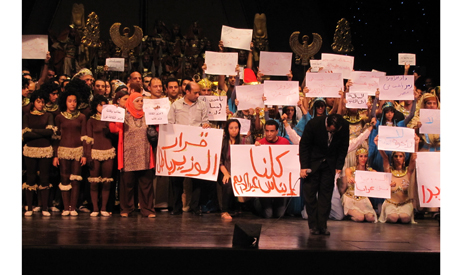
Can you imagine... what if you went to the Met Opera (Or LA, Houston, San Francisco, San Diego...) planning to see Verdi's Aida but, when the curtain rose, the stage was filled with 300 musicians, singers, dancers - all dressed in their costumes - holding protest signs.

What's more: can you imagine how our operatic elite would react? I mean, I can't.

Well Ladies and Gents, that is exactly what happened at the Cairo Opera House this week following the firing of opera house head Ines Abdel-Dayem by the new culture minister, Alaa Abdel-Aziz. Needless to say, people were not pleased.

Abdel-Dayem is the third in a series of firings of senior officials by the new minister of culture since he took office three weeks ago, after Ahmed Mujahid, head of the Egyptian General Book Authority, and Salah El-Meligy, head of the Fine Arts Sector, were given the ol' heave-ho.

AhramOnline reports:
A rumour that Abdel-Dayem would be dismissed surfaced several days ago, and was met with a small-scale protest by artists. On several occasions in recent days the minister denied plans to sack Abdel-Dayem.

Following the official announcement of Abdel-Dayem’s dismissal on Tuesday morning, the minister named Reda El-Wakil, currently head of the Artistic House at the Cairo Opera House, to be her successor.

El-Wakil stated on his Facebook page: "I decline to accept the position…the entire Cairo Opera House family trusts Dr. Ines Abdel-Dayem, and wishes her success in resuming her post as head of the Cairo Opera House."

Also on Tuesday, lawmakers in the Shura Council were discussing the budget of the opera house, and recommended that it be reduced. One of the members of the Islamist-dominated Shura Council also suggested that ballet performances should be cancelled, due to the "nudity" they entail. The suggestion, however, was not given further consideration.

Abdel-Dayem told Ahram Online on Tuesday that the decision to fire her prevented her from joining the Shura Council session to defend the Opera House’s budget. Principal conductor and artistic director of the Cairo Opera Orchestra Nayer Nagui told Ahram Online that "the current budget is barely sufficient to cover the expenses of a musical season."
The protests started outside - and they were small-ish in nature. Starting outside the gate of the opera grounds, the small group of artists and supporters were reportedly chanting and holding banners reading: "the opera is a red line," "we are all Ines Abdel-Dayem," and "opera is an expression of Egyptian culture."

Again, from AhramOnline:
Shortly after 7pm, the musicians poured into the opera house, as at 8pm they were expected to perform Verdi's Aida. Smartly-dressed audience members started to fill the hall.

However, when the curtains were raised, they revealed a staged filled by over 300 musicians, singers, ballet dancers – the complete cast of Aida joined by other artists and administrative personnel – dressed in their costumes, holding protest signs instead of props.

Artists from the Cairo Opera Orchestra, Cairo Opera Company, Cairo Opera Ballet Company, Cairo Opera Choir, Acapella Choir among many others held signs condemning the minister of culture and expressing solidarity with Abdel-Dayem.

Nayer Nagui, artistic director and principal conductor of the Cairo Opera Orchestra made a statement to the audience.

"In solidarity with Dr. Ines Abdel-Dayem, head of the Cairo Opera House, and with respect for her role, we, the artists and staff of the Cairo Opera House, have decided to refrain from performing the opera
Aida tonight. This is the first step towards halting all the activities of the opera house until the removal of the culture minister, who has been making arbitrary decisions against prominent leaders in the ministry, in an attempt to change the identity of this country."
Staff and musicians have vowed to keep striking until the culture minister steps down.

Friday, April 5, 2013

Are young singers unreliable? Or are the fundamentals of opera changing?

Legends Caballe and Horne in rehearsal.
Here we are. Again.

Last month, Sir Antonio Pappano created a furor when he made some comments about what he sees as a new trend of unreliable young singers who have a propensity for cancelling. Norman Lebrecht of Slipped Disc reported that Sir Antonio said:
It happens more and more. There’s something about this generation of singers, that they are weaker in their bodies or don’t care. I don’t know what it is, but it’s something that is very very frustrating for me personally.
This led the Met Opera's Principal Conductor, Fabio Luisi, to respond:
Dear Norman,

I think nobody, not even Tony, came to the core of the problem, and we, as conductors, have to pronounce a very clear “mea culpa” in this. Most singers, especially the young ones, are simply too young, not prepared enough, with technical problems and they get the wrong roles. Take e.g. a good, young soprano who makes a successful debut with, let’s say, Micaela or Liu’.

Some agent will eventually ask her if she could take over Violetta, then Leonora (Trovatore), at the end probably Butterfly or Tosca. “You know, darling, they are looking for a new, young and pretty Tosca in that international Opera House, director and conductor would love to have a new voice, they would love to discover a new star. That’s you!”

It can work maybe a couple of times, if the orchestras are not too loud, if the director is understanding, if the conductor helpful (not looking for Magda Oliviero’s sounds). Of course, we do need Butterflies and Toscas, but are they the right roles for a young soprano? Definitely not. You can sing them of course, with a fresh voice, but not for long. So they start to cancel – and then they disappear.

Gruberova never accepted such roles (she sung even Violetta not very often) – and she still sings. If I read that the Nemorino-tenors are approaching Des Grieux (Puccini) or Cavaradossi, of course I am curious, but I already can see… it won’t last long. How many singers, Norman, have we seen “bruciati” by famous conductors? Freni and Butterfly? She was smart enough to do it only once (and, as soon as I know, never on stage), but she had a 40 years long career. Gruberova ditto.

Best regards to all.

Yours
Fabio
Maestro Luisi wasn't the only one to weigh in (so to speak). Two famed mezzo sopranos, Susan Graham and Rosalind Plowright, also had a few things to say on the matter.

But, I still don't think the core of the issue has been touched. I think the root is something that I've been harping, gnashing and wailing about since day one of A Liberal's Libretto.

You see, we are at a place in opera's history when it appears that the fundamentals of the opera world are changing. Opera is a big art form which requires big orchestras, big voices, big gestures and big personalities. It has always been centered around the voice and around making a sound big enough to cut over the orchestra and to fill a house without amplification. That sound must be healthy and should be cultivated and cared for in a manner that will promote longevity. But, cultivating longevity no longer seems to be the focus. Indeed, opera now seems to be metamorphosing to fit a small, very confining screen - be it the TV or Movie Theater screen. Part of the metamorphosis is the focus on singer's looks as opposed to their voices.

Soprano Sondra Radvanovsky called out some of her colleagues about this very thing:
We’re singers and we make funny faces, and this is broadcast around the world. I think a lot of my colleagues have done various things to make themselves look better on camera.
As the opera world changes, I think it has become taboo to celebrate why opera is different from everything else - instead, we try to make it "mainstream".

Opera is *anything* but mainstream.

How does Teddy Tahu Rhodes build stamina? Hint: Not by singing.
I will make this point though: Even though Maestro Luisi doesn't tackle the full enchilada, he is still quite correct. Companies, (and agents... and conductors) are always looking for a 20 year old to sing, for example, Butterfly or Tosca. In addition, many of the companies who are looking for the 20 year old Butterfly or Tosca, also mandate that she be size 4 or 6.

Have these people not figured out yet that it is these young singers who are so consumed with being the size 4-ish, 20 year old, Butterfly that all they eat is a salad with lemon juice and a grilled chicken breast for lunch before a performance. Then, they're out of energy before they even hit the stage. Subsequently, they end up pushing themselves through a show ... and that means pushing their VOICE through the show.

After only a short time of that, the voice ... and the immune system ... start to break down. At which point, many current singers simply have vocal surgery to repair the damage and try to go back to work. Not realizing that every time they have another nodule hacked off their vocal-fold, it's making the vocal mechanism a little weaker.

Lather. Rinse. Repeat.

As the demand grows for younger opera singers with the Hollywood look, I believe that we’re getting away from the type of singers that can sing -truly sing- operatic roles in the way in which they were intended to be sung and with some regularity. Some of the current crop of singers sound immature and, quite frankly, anemic. In fact just last week, Elizabeth Frayer wrote this about the Met Opera's Otello:
Now, I don’t know if it was our seats or the production, but I had a very difficult time hearing. It seemed that many of the singers’ voices were not big enough for Verdi’s Otello.

At times there were large groups of people on stage but only one person singing and I could not tell who was singing. I started to wonder if I needed to get my hearing checked. There was one point where the Met titles implied Emilia was singing, but I couldn’t hear a peep...
And she's not the first person I heard this from. One friend, who has a season subscription to the Met, and has had for decades, thought he should have his ears checked because he was continually having a harder and harder time hearing singers on the Met stage. Well, he did. And, his ears are fine.

To be fair, I don't think the singers, their technique, their travel schedules, their diets or their exercise regimes are the only ones at fault, per Pappano. And, I don't think the opera companies, conductors, agents and directors are the only ones at fault, per Luisi.

I think the crux of the issue lies with the current migration away from the fundamentals of what makes opera what it is - what makes opera different and what makes opera grand. I continue to maintain that turning opera into something mainstream ... or normal ... or usual ... or ordinary ... is breaking it down.

All in the name of making opera look like everything else we see on TV.

Speaking of young singers and TV - check out this little gem. And, I use the word "gem" very loosely.


We all know that, from time to time, I have raised question regarding the Met Opera's general manager Peter Gelb. Clearly though, Gelb is doing something right. This change in the fundamentals of opera has, at the very least, been good for the Met and for Gelb. Here's a snip from a recent NY Times Article, The Epic Ups and Downs of Peter Gelb:
The job of Met Opera general manager is as iconic in its way as mayor of New York or manager of the Yankees. By any standard, Peter Gelb, now well into his seventh season, has established his tenure as among the most significant in the Met’s 130-year history. Giulio Gatti-Casazza saw the company through the stock-market crash and the depths of the Great Depression. Rudolf Bing delivered it to its new home at Lincoln Center. Gelb has guided the opera company into the digital age and has put an art form long associated with aristocratic privilege on a more populist footing.

Annual new productions at the Met have nearly doubled; geriatric demographic trends have been arrested, if not reversed; fund-raising is setting records. The Met now has a 24-hour channel on SiriusXM radio; an iPad app; education programs in more than 150 schools in 21 states; subsidized tickets; free dress rehearsals. When Gelb became general manager in 2006, the number of subscribers surged and the percentage of sold-out shows rebounded off historic lows. Subscriptions and the percentage of house seats sold have tailed off in the past few years, and the Met recently had to roll back last season’s 10 percent ticket-price increase, but these negative box-office trends have been offset by the growth of the audience for the Met’s “Live in HD” broadcasts, which Gelb initiated and which last season drew 2,547,243 viewers in 54 countries.

“Peter’s record of achievement and ambition is unparalleled — I think he’s saved the Met from brontosaurusdom, and I say that as someone who has been going to opera since 1958,” says André Bishop, who as artistic director of Lincoln Center Theater has joined Gelb in establishing a commissioning program for new operas and musical-theater pieces.
Can this operatic climate change last? And if it does, will the young singers of today possess the longevity that is needed to build the next generation of operatic legends?

Is building longevity in the next generation of singers even a priority? I mean: once a singer gets past a certain age, will they -like in Hollywood- be passed over for roles that are then given to the younger, more attractive singers?

[SIGH] It certainly seems like we are headed down that road. And some would say we are already there.

Tuesday, March 5, 2013

Tenor Massimo Giordano to release debut album with BMG

Massimo Giordano is not quite as well-known as some ... but, he is one of the world’s leading tenors.

So, it's about time that he release his debut album, right? Well, it's happening: Massimo Giordano is poised to release his debut album exclusively with BMG. This will be the first classical solo artist album from BMG since BMG and Sony broke up in 2008.

His soon-to-be-released album will feature exactly what it should as Giordano's first - arias directly from the standard tenor buffet: Verdi, Puccini and Giordano.

Born in Pompei into a working class family, Giordano did not study music until he decided to move to Trieste to study classical singing and flute. He made his operatic debut in Spoleto in Massenet’s Werther.

After conquering the opera stages in Italy, Massimo Giordano began singing in all the major international houses of the world some 10 years ago. Giordano made his Met Opera debut in 2006 as Des Grieux with Renée Fleming as Manon ... you see, whether it be at La Scala in Milan, Glyndebourne Opera, Vienna State Opera or Royal Opera House - Covent Garden, you can be sure that Giordano will be sharing the stage with the likes of notable Divas and will be under the baton of such conducting luminaries as Claudio Abbado, Fabio Luisi and Marco Armiliato...

Friday, February 1, 2013

Black History Month: Maestro Henry Lewis

I first ran this post in February of 2010. But, given that today kicks off Black History Month, I thought I would revisit it because I don't think this particular trailblazer of our industry gets enough credit for the racial barriers that he met and subsequently tackled.

You see, he not only became the first African American instrumentalist in a major orchestra, but at the time, was also the youngest - being just 16 years old. This gentleman broke racial barriers as a musician, and then went on to do the same as a conductor. He was the first African American to head a major symphony as Music Director and was also the first African American to conduct at the Metropolitan Opera.

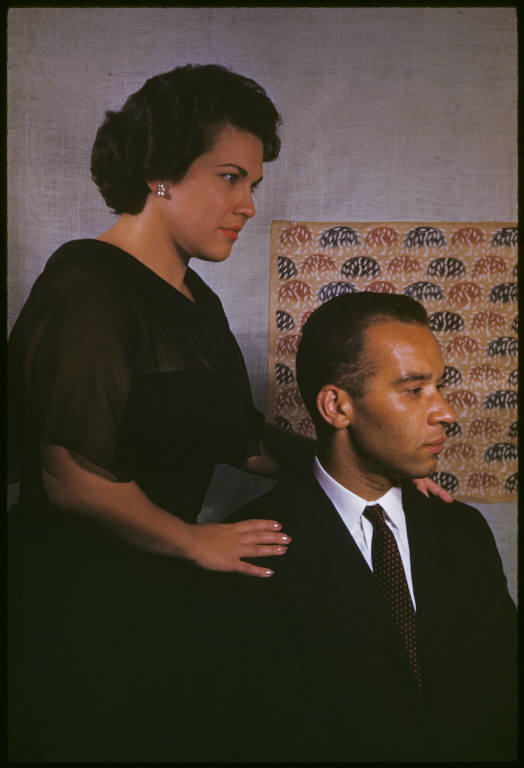
This musician and conductor was, of course, Henry Lewis.Unfortunately, Henry Lewis seems to be known more for being the ex-husband of mezzo soprano Marilyn Horne than for his own accomplishments [Pictured right, in 1961]. In fact, if you do a Google Images search for Henry Lewis, Conductor Henry Lewis, Musician Henry Lewis or any number of other versions, you'd be hard pressed to find an imagine in which Lewis is without Horne. But, Marilyn Horne always gives Lewis credit where credit is due. In her autobiography, Marilyn Horne: My Life, Ms. Horne says:
Henry Lewis was my prophet and my teacher and my right hand ... I certainly would have had a career without Henry, but it was he who really led me into the paths of bel canto. He labored and sweated and did everything he could to teach me the style.
Also, it was Lewis who put a young Marilyn Horne up to auditioning to be the singing voice for Dorothy Dandridge in the movie version of a musical based on Bizet's opera Carmen; Carmen Jones. Horne got the part and dubbed for Dandridge.

Henry Jay Lewis was born on Oct. 16, 1932, in Los Angeles. He was the only child of Henry J. Lewis, an automobile dealer, and Mary Josephine Lewis, a registered nurse. His mother set him down at the piano when he was only 5 years old, much to displeasure of his father who wanted Lewis to become a "respectable, professional man - not a musician". [NY Times]

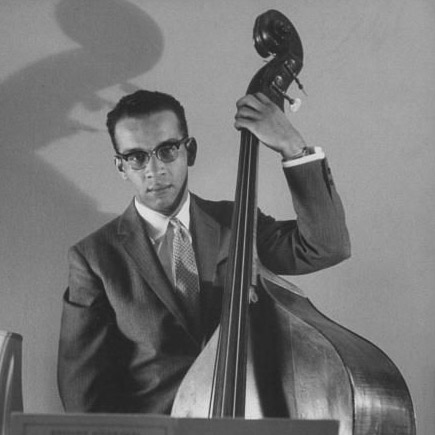
When Lewis was in Junior High School, his teacher offered lessons on the double bass. Lewis made the decision to master the double bass because double bass players were rare. He also studied other instruments and voice. But, it was his double bass playing that got him a post as instrumentalist with the Los Angeles Philharmonic when he was just 16 years old - the youngest person to do so, as well as the first African American.

In addition to his post with the LA Phil., his talent and prowess on the double bass won him a scholarship to the University of Southern California. He never graduated, but took more than enough credits to have done so. Later in life, Lewis made up for his lack of degrees by receiving many honorary degrees from several institutions.

Lewis served in the U.S. Army from 1954-57. He not only served with the Stuttgart, Germany-based Seventh Army, but was also the conductor of its Symphony Orchestra.

In 1960, Henry Lewis married Marilyn Horne. In her autobiography, Ms. Horne wrote that she received many warnings from friends and relatives alike about problems that would arise from an interracial marriage in the '60s. She writes about a particularly difficult comment which came from her mother:
'What do you want to marry him for?' Mother said shortly. 'Why can't you just live with him? Be his mistress, for God's sake, not his wife!'
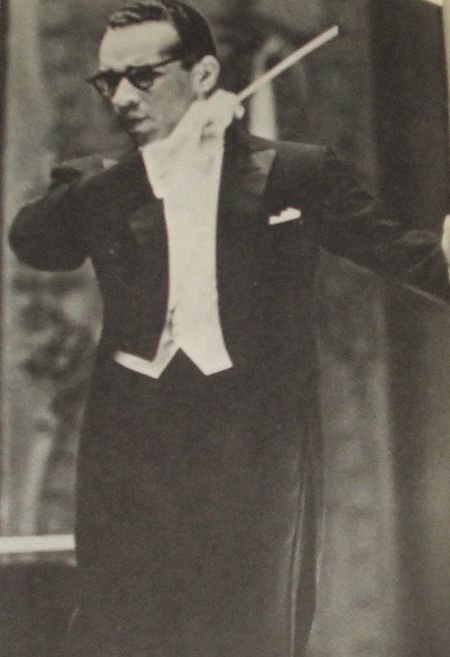
Henry Lewis gained national recognition for the first time in 1961 when he was appointed to the post of assistant conductor of the Los Angeles Philharmonic under Zubin Mehta. In 1968 he became the conductor and musical director of the New Jersey Symphony and was the first African-American to lead a major symphony orchestra. Lewis transformed the small community ensemble with an average yearly budget of $75,000 into a nationally recognized orchestra with a budget well into the millions.

In 1972, Henry Lewis spent his 40th birthday on the podium of the Metropolitan Opera, becoming the first African American to conduct there. He joined forces with the MET again in 1975 to conduct their tour of Japan.

After a rocky relationship with the New Jersey Symphony, Lewis resigned from his post as Music Director in 1976. According to the New York Times, Mr. Lewis said he had imposed stern but reasonable demands on the orchestra's members, but they called him tyrannical. In a three-week strike that preceded his resignation, its is said that the orchestra's negotiating committee actually sought a contract clause stipulating that Lewis refrain from frowning at rehearsals and performances.

Seriously? A conductor not frowning at rehearsals and performances? They might as well have asked him not to wave his arms.

Henry Lewis continued to conducting after leaving his post at New Jersey, though. He not only served as music director of the Opera-Music Theater Institute of New Jersey but also as principal conductor of the Netherlands Radio Orchestra. He also continued touring Europe and America as a frequent guest conductor for opera companies and symphony orchestras.

During their marriage, Marilyn Horne and Henry Lewis - whose daughter Angela was born in 1965 - often appeared together and were the subject of magazine articles that showed them as happy in their music and their marriage. Unfortunately, their marriage ended in divorce in 1979. But, they remained colleagues and more importantly, close friends.

A 1984 article in PEOPLE Magazine put it this way:
... the figure of another man broods over Horne's life: her ex-husband, the conductor Henry Lewis. When Horne gave her American Song-book concert at Lincoln Center, [Horne's companion Nicola Zaccaria] was in Greece. It was Lewis, 51, and their daughter, Angela, who waited backstage with champagne to toast the diva. They speak of each other with a plangent affection. "She's a very, very important person in my life," he says. "There's a niche for her within my heart." Horne echoes him: "There's a deep friendship and a very deep love that will always be there."
Just 12 years later - in 1996 - after battling Lung Cancer, Henry Lewis died at his home in Manhattan of a heart attack. He was only 63 years old.

Lewis' legacy is immeasurable. He contributed greatly to helping build the technical and musical foundation of one of the greatest singers of all time - and also paved the way for African American musicians and conductors alike.

Tuesday, October 16, 2012

Another Favorite Clip: Random Act of Opera from Florida Grand

It's been a while since I've share Another Favorite Clip with you, friends. So, when I came across this gem on Twitter this morning I simply had to share.

Pleas sit back and enjoy as Florida Grand Opera helps the IKEA store in Sunrise, Florida celebrate its 5th anniversary with a Random Act of Opera!

Friday, October 12, 2012

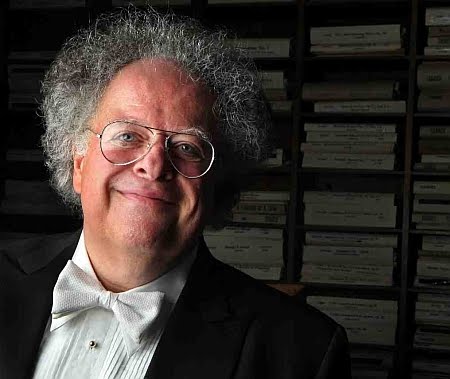
Maestro James Levine will return to the podium in 2013

Maestro James Levine
Still smiling from ear to ear after Vice President Biden wiped the floor with Congressman Ryan in the Vice Presidential Debate last night ...

And, just when I thought I could smile any more, I was greeting by an email update this morning on the condition of Maestro James Levine ... who has been absent from the Met Opera following a series of debilitating health issues.

The Met’s General Manager, Peter Gelb, announced on Thursday that the beloved Maestro will return to conducting on May 19, 2013 with the MET Orchestra at Carnegie Hall. He will then lead three operas in the Met’s 2013-14 season, including a new production of Verdi’s Falstaff and revivals of Mozart’s Così fan tutte and Berg’s Wozzeck. He will also conduct all three Carnegie Hall concerts that season.

In recent weeks Levine, who is still recovering from a spinal injury due to a fall in August 2011, has already resumed some of his duties as the Met’s Music Director, coaching members of the Met’s Lindemann Young Artist Development Program, holding artistic planning sessions, and meeting with the Met’s Orchestra and Chorus.

Regarding his return, Maestro Levine said:
I’m feeling better with each passing day and look forward to returning to the company I love so much. It has been a long healing process, but with a team of excellent doctors and the unwavering support of my friends and colleagues, I’m looking forward more than I can say to getting back to work.
As per usual, Peter Gelb stated the obvious:
Jim’s return to conducting is the welcome news that our company has long been waiting for, and it is also great news for opera lovers throughout the world.
I know, I shouldn't be too critical of Gelb. With many in the opera world often asking when Mr. Levine would be back, Mr. Gelb was under pressure to make a decision about Maestro Levine’s long-term status. But, he said he would not do so as long as there was any hope at all that Maestro Levine would conduct again. That's certainly commendable on Gelb's part.

Anyhoo - in addition to announcing Maestro Levine's return, the Met - in an apparent attempt to answer as many questions as possible in one swoop - has also released extensive information from his team of doctors...

Maestro Levine has been in long-term rehabilitation since his fall and injury in August 2011, which required surgery and left him partially paralyzed. Based upon recent examinations, his team of physicians has expressed uniform optimism about his ability to resume conducting.
Dr. Len Horovitz, Attending Physician at Lenox Hill Hospital and Levine’s personal physician who coordinates his medical team, said, “James Levine is an inspirational case, whose return to conducting will be a result of remarkable perseverance and hard work.”

His neurosurgeon, Patrick O’Leary, Associate Attending Spine Surgeon at the Hospital for Special Surgery and former Chief of the Hospital’s Spine Service, who performed the recent operations on Levine’s spine, said that he was making a dramatic recovery. “He is no longer in need of additional surgery, his upper body strength is remarkable, and his prognosis is good.”

His neurologist, Edward Reich, Senior Attending Neurologist at Lenox Hill Hospital, said, “Neurologically, he is fit to return to conducting. With his intensive rehabilitation, his upper body strength is greater than it has been in years.”
While it is evident that he has regained his upper body strength, the injuries have left him temporarily unable to walk. For the time being, he will conduct from the motorized wheelchair in which he uses to get around. In anticipation of his return, the Met’s technical department is designing customized, elevating podiums that will be utilized on the Carnegie Hall stage and in the Met’s orchestra pit.

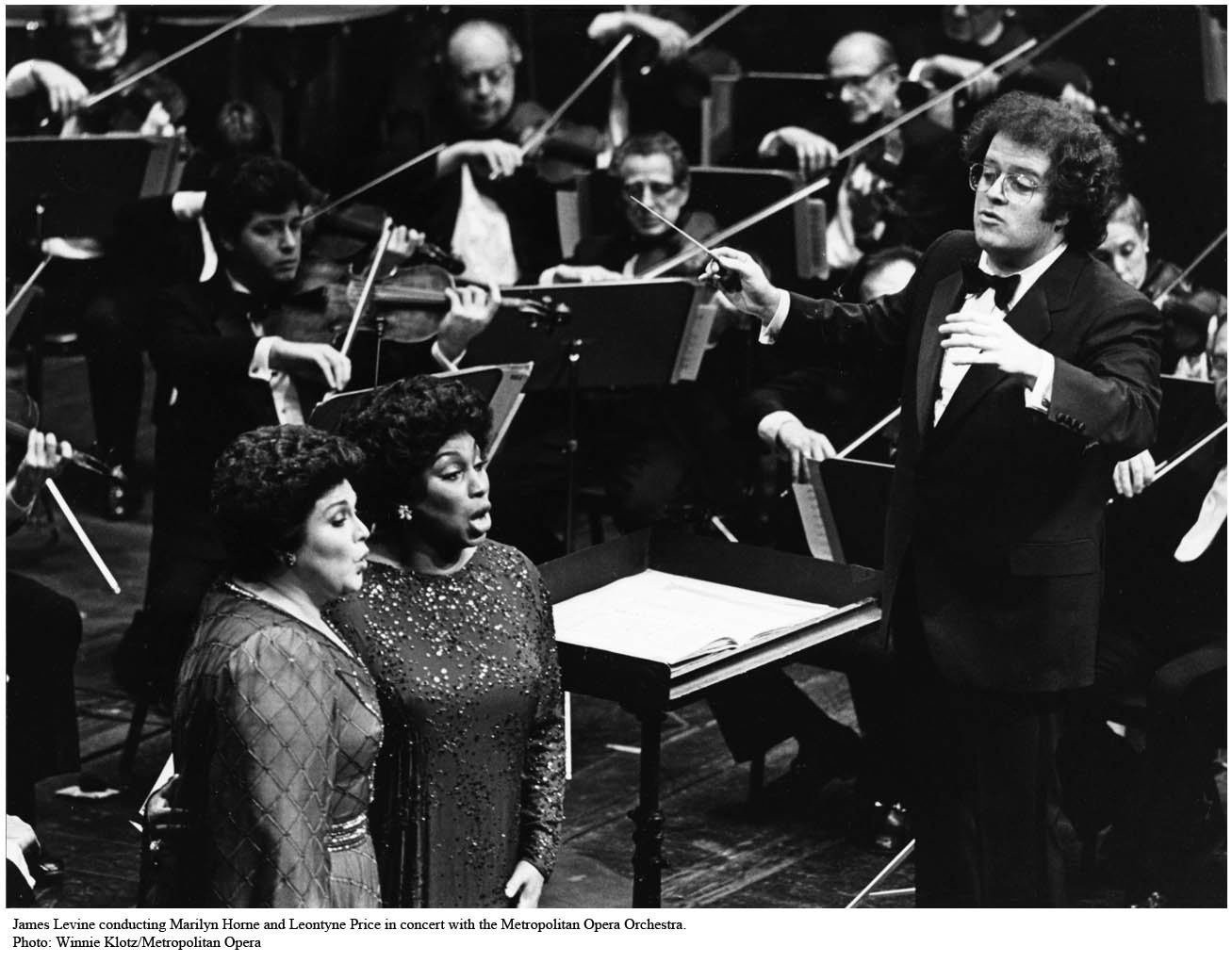
Maestro Levine conducts Marilyn Horne and Leontyne Price.
To be honest, I'm very glad they're making these adjustments for Maestro Levine. It's only proper given his stature with the company and the opera world in general. Let's not forget that his 40th anniversary with the company was just celebrated last year. He debuted with the company in 1971 and later became the Met’s Music Director in 1976. Since his debut in 1971, Maestro Levine has conducted 2,441 performances - that's more than anyone in the company’s 129-year history.

Conducting all of those performances, as well as a heavy travel schedule pertaining to his conducting abroad, left Maestro Levine's body in a state of breakdown. As you may remember, prior to his fall in 2011, Levine had undergone other surgeries to correct problems with his upper and lower spine, including stenosis, and fractured and herniated discs, which had caused severe and debilitating pain.

But, above and beyond that, there was something that was going on with Maestro Levine that he chose not to disclose to the public in order to guard his privacy. Indeed, since 1994 Maestro Levine has been suffering from, and being medicated for, Parkinsonism, which is a relatively benign form of the disease from which it gets its name ... its considered relatively benign because it does not progress.

Dr. Stanley Fahn, the H. Houston Merritt Professor of Neurology at Columbia University, has been treating Levine for the disease in recent years. He said:
Since 1994, Maestro Levine has shown symptoms of Parkinson disease. They mainly affected his legs and also caused a mild tremor in his left hand. Fortunately, the symptoms have changed little over the years and have been suppressed with medication. This lack of progression indicates a benign form of Parkinson’s, rather than the more typical form, in which symptoms steadily worsen. In the past, Maestro Levine’s symptoms were aggravated by the stress of severe back pain. Now that he is pain-free, his mild Parkinsonism should have little impact on his quality of life and his return to conducting. His upper body strength and dexterity are quite remarkable.
While Levine is resuming his duties as Music Director, Fabio Luisi is also continuing in his role as Principal Conductor. Peter Gelb praised Maestro Luisi's presence:
The Met is extremely fortunate to have Fabio's strong presence in the pit. The orchestra and chorus admire him greatly and both Jim and I are very grateful for all that he brings to the Met with his artistry and continuing presence.
Cheers and welcome back, Maestro Levine! The world looks forward to having you back on the podium.

Thursday, September 13, 2012

Francesca Zambello gets a promotion at Washington National Opera

Congratulations to Francesca Zambello!

Washington National Opera announced today that famed director, administrator and avid scarf-wearer Francesca Zambello will be promoted from the position of Artistic Advisor to Artistic Director, effective January 1, 2013. She has served as the company’s Artistic Advisor since June 2011.

This move is said to have finally solidified its reorganization after the departure of Placido Domingo and WNO's merger with the Kennedy Center.

As Artistic Director, Zambello will have responsibility for the company’s artistic vision and direction, including repertoire and casting. She will work in close collaboration with Kennedy Center President Michael M. Kaiser, WNO Executive Director Michael L. Mael, and WNO Music Director Philippe Auguin to further the company’s long history of artistic excellence. She will also oversee the artistic growth of the company’s Domingo-Cafritz Young Artist Program and will guide the future of the American Opera Initiative, WNO’s new American opera commissioning program. She will continue to direct one production each season.

WNO Board Chairman Jacqueline B. Mars says:
Cesca is both a brilliant director and a highly effective administrator. Her stature in the international opera community enhances the company and I have great confidence that she will take WNO in a positive direction.
As for Ms. Zambello, she is very much looking forward to jumping right in and continuing to make her mark on the future of WNO and opera in general:
It will be an enormous pleasure and honor to expand my role with WNO as its Artistic Director, maintaining the high standards set by my predecessors and leading WNO into the future. I will respect what appeals to our long-time patrons and supporters while at the same time work hard to attract new audiences to opera. I look forward to raising the profile of the Domingo-Cafritz Young Artist Program, continuing the great work already underway with the American Opera Initiative, and highlighting special and unique repertoire and artists that only the intimacy of the Kennedy Center affords us. This is a challenge I embrace unequivocally, and I look forward to sharing more of my plans in the coming months.
Francesca Zambello has enjoyed a storied career as both an opera director and an arts administrator and has an extensive history of success with WNO. She has directed numerous productions for WNO and will direct her new production of Show Boat in May 2013. As previously announced, she will bring her much-admired Ring cycle back to Washington in the spring of 2016. She also serves as the Artistic and General Director of the Glimmerglass Festival in upstate New York, where she recently directed an acclaimed production of Aida.

Thus opens a new chapter at Washington National Opera.

Wednesday, August 22, 2012

OPERA NEWS incites dialogue on the bland and generic future of opera.

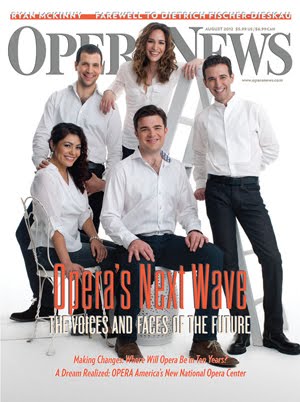
August 2012 issue of OPERA NEWS
I know. I'm kind of shocked, too. The August issue of OPERA NEWS has sparked debate about the future of opera.

As you'll remember, last month I discussed the OPERA NEWS issue from the stand point of optics. But, if by some act God you were not able to read the post - not worries ... we'll review:

A word has been thrust onto the political stage over the last few years. The word is, optics. Look up the word optics in a dictionary, and you're likely to find a very scientific definition along the lines of 'the study of light and vision'. Put in the context of a politician or political campaign, optics refers to the way a situation is perceived by the general public ... as in: how an event, course of action, etc. looks to the general public.

Generally when I see the cover of OPERA NEWS upon its arrival, I can tend to be a little critical if the image isn't good. (I've been concentrating like crazy on images lately.) I'd be lying if I denied the fact that sometimes I do wonder quite out loud: "Who is in charge of picking these damned cover photos"?

There was one in particular in which a female opera singer was wearing a summery sun-dress, under which, she clearly could have benefited from a well fitting undergarment. All truth. Go ahead: hashtag it.

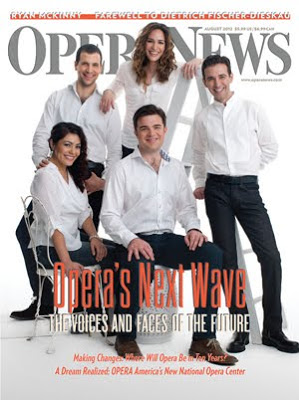
August's issue of OPERA NEWS highlighting Opera's Next Wave - The Voices and Faces of the Future might take the critical-cake for me, though. On the cover [upper right], we see soprano Ailyn Perez, bass baritone Luca Pisaroni, mezzo-soprano Kate Lindsey, conductor Michael Christie and countertenor Anthony Roth Costanzo, seated or standing in various positions, all looking quite happy and jovial against a white backdrop. The photo itself, taken by James Salzano, isn't all that bad - but, to be honest, it looks more like a high school dance photo than it does a magazine cover.

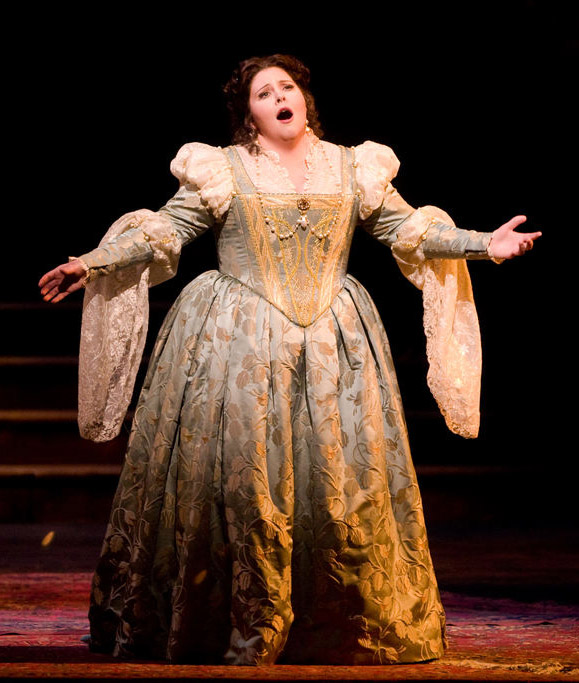
Now, let me be perfectly clear, I have no doubt whatsoever that these folks will contribute to the future of opera. So too will the many folks who are not featured on the cover but are featured inside the magazine: sopranos Angela Meade [R.], Amber Wagner and Latonia Moore, mezzo-soprano Isabel Leonard, composer Nico Muhly, conductor Anne Manson and the like.

As OPERA NEWS very carefully explains in their Viewpoint section:
This issue of OPERA NEWS takes a look at some of the people we feel will be increasingly important during opera's next decade. The list of names that we have chosen isn't meant to be exhaustive or all-inclusive; in a field as well stocked with talent as opera, there were literally scores of possibilities for this issue. We chose to concentrate on individuals whose artistic and professional progress had caught our attention in the past few seasons - and whose exceptional talent, ambition and energy have allowed them to thrive in a field that will always be rich in challenges. These are men and women who have come a long way in the past decade: for example, in 2002, the majority of the singers featured in this issue had not yet made their professional debuts.
But, back to optics - or how an event, course of action, etc. looks to the general public.

OPERA NEWS has stated that the question of how to attract new audiences to a seemingly "old" art form is one that needs to be answered urgently, as consumers today are bombarded with a mind-boggling array of entertainment options. And, the Met in particular, has spent quite a lot of time and money trying to re-brand opera ... making it appear to be more accessible. Not only by physically making it accessible through its Live in HD and On Demand programs but, also by making the productions themselves "look" more "mainstream".

And now, here we have what is undoubtedly opera's premiere news magazine - published by the Met's Opera Guild, NOT the Metropolitan Opera - discussing the key players in the future of opera. On the cover of the issue, we see the future of opera in dark jeans and white shirts against a white background ... plain, vanilla, stark, barren and, quite frankly, vapid.

THIS is the future of OPERA? Generic, void, cold, bland and characterless?

Say it ain't so! Or is it?

Since the issue went into circulation many have cussed and discussed the future of opera.

Zachary Woolfe wrote for the New York Times:
This art form, with its enormous casts, sets and orchestras, and its armies of stagehands and administrative staff, was a dubious financial proposition even before the most recent downturn. I was once told that the good opera company directors are those who lose money responsibly...

...The repertory is largely stagnant, focused on the same small group of hits. The few big stars who remain — the Plácido Domingos, Renée Flemings and Anna Netrebkos — are needed to sell almost anything that is not “Aida,” “Carmen” or “Turandot.”

The typical production style is blandly nostalgic escapism rather than vibrancy or relevance. This was the case through much of America in the 20th century, and there hasn’t been much change so far in the 21st...

... But until opera stops being associated with escapist nostalgia
[Woolfe speaks specifically of movies like Moonstruck and Pretty Woman.] and fancy dates, it is doomed to struggle for relevance.
While Anne Midgette writes for The Washington Post:
...I say I’d like to see more focus on the music — not just in such discussions, but from those who are casting and conceiving of opera seasons for the coming years.

Here’s a case in point: the soprano Angela Meade, who gets a lot of deserved praise in this discussion. Does she have the voice? Indubitably. Does she have the stage presence? Not yet, and I don’t think it’s entirely her fault...

...Meade has the vocal chops, and she also seems like an appealing personality, but in trying to shoehorn herself into a serious tragic-heroine mode in “Ernani,” she squeezed the personality, and consequently some of the thrill, right out. I hope she figures out how to insert more of herself into her dramatic performances, because ultimately, the future of opera rests precisely on the vocal presences and vocal personalities that get audiences excited and make them want to come.
After "someone misconstrued" her post, Midgette qualified her remarks in a separate post saying in part:
This quality of persona has always been a part of what makes opera exciting. And you can’t always predict who will develop it. Take Luciano Pavarotti. At the start of his career, he wasn’t, by all accounts, anything special to watch on stage at all. He developed into something of a stage animal, with a legendary magnetism. He certainly luxuriated in the music he was singing. But he was never much of an actor.

This is what I meant about Angela Meade; and this is an aspect of the operatic art that I think tends to get lost today in training that focuses on all of the individual elements of opera -- singing, diction, language, and, yes, acting -- but not enough on what it takes to get out there and dazzle an audience.
Indeed, the OPERA NEWS snippet on Angela Meade - which was then tweeted from @OPERANEWS - doesn't shy away from pointing out quite vividly that Angela Meade is an opera SINGER not an opera PERFORMER: "she has become a kind of heroine for opera-lovers who place vocal standards well above theatrical ones."

NPR also got into the fun by using the OPERA NEWS cover story as a jumping off point for the discussion Is Opera Ailing? A Conversation About The State Of The Art. You'll have to check that one out on your own so I can get to my point.

Here's the bottom line for Yours Truly...

No one is going to agree on what the future of the art is. But, I have contended here before that ultimately, it appears that the fundamentals of the opera world are changing - not necessarily for the better. And, I think it's key that we have to understand why that is before we can settle on what the future holds.

Opera is a big art form which requires big voices, big gestures and big personalities. It has always been centered around the voice and around making a sound big enough to cut over the orchestra and to fill a house without amplification. In addition, gestures and movements have traditionally been very big in order for those seated at the back of the house to be able to see what's going on.

But at this point in time, some people are trying to change that ... they're trying to fit a grandiose package into a small, very confining space. In fact, I think Zachary Woolfe was onto something... but, perhaps it's not the movies that are the problem - it's the movie screen.

I'm sure you've read about when the movie business transitioned from silent pictures to "talkies". The actors and actresses had to transition they way they acted from overly theatrically-big gestures and facial expressions (which compensated for the lack of spoken word) to a much more subdued way of acting. Today, opera singers who appear on the HD screen are having to do the same. A gesture that would be used during a performance in order for the people in the back of the house to see it, will have to be toned down when the HD cameras are running. And what's more is that the facial expressions that we singers make from time to time in order to produce the sound needed to fill the house, also have to be toned down.

I see it akin to putting a beautiful butterfly into a jar so you can look at it. Not only will the butterfly die sooner - but, part of what makes a butterfly beautiful is seeing it flit about.

I'm suddenly reminded of a tweet I saw in which a singer had asked her father how he like the HD Broadcast he saw that day. Her father's response was something akin to "I really liked it because they didn't look like they were singing.... they looked like real people."

Whether in HD Broadcasts or perhaps in the Movies too, I think putting opera in the movie theaters is skewing the desires of opera's true audience - in a purely psychological manner. When we go to a movie at the local movie house, we see perfectly made-up, perfectly dressed, perfectly sculpted, perfectly scripted, high-budget movies starring the Hollywood-ideal of men and women. So, it also stands to be true that when we go to the local movie house again, but this time to watch Tristan und Isolde, Lucia di Lammermoor, Tosca or even La Boheme - we can’t help but assume that since we’re sitting in the comfortable seats with our nachos, popcorn and silo of Diet Pepsi, that the people on the screen will look just like they do in a Hollywood movie.

It might be over simplified ... but, remember Pavlov and his dog? I think they were onto something there.
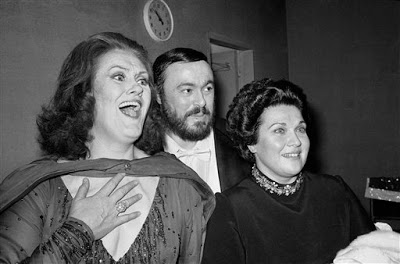
Legends Joan Sutherland, Luciano Pavarotti and Marilyn Horne.
I’m afraid that the days are numbered for opera singers who are magnetic on stage and sing the hell out of a role, but don’t have the Hollywood looks. It makes me wonder: would singers like Caballe, Sutherland, Horne, Norman, London or even Pavarotti have ever had a chance in this day and age? They were all beautiful in their own way, but certainly didn’t fit a “mold”.

It seems that as soon as opera was put on the HD screen, it was assumed that audiences were no longer smart enough to employ the suspension of disbelief. Remember when a singer was cast to sing a role because he or she would truly be remarkable doing so? They may not have even "looked the part" but, the voice carried the performance ... As in when African-American soprano - and legend - Leontyne Price sang the role of a Japanese Geisha Cio-Cio-San. Stunning.

I believe that beyond the gestures and what people are accustomed to seeing in a movie theater, the movie screens are contributing to a larger problem. I think that opera is on the road to Bland-ville. And interestingly enough, the OPERA NEWS cover illustrated my point rather well.

Opera is on a path where emphasis is no longer about the singing, what makes opera unique or what makes opera the grand art form that it is (or was). Instead, a great deal of focus is being placed with laser-like precision on people looking like a Hollywood star. Or, at least "looking the part" ... however bland that might be. All so the-powers-that-be can fool themselves into thinking that opera is becoming more "mainstream" - which, it's not ... nor should it.

What we do as opera singers is far from "mainstream". What we do is different. Opera is huge, loud, colorful, awe-inspiring, distinctive, incomparable and let's be honest ... a little abnormal. Perhaps they we should be celebrating what sets opera apart from everything else out there and should be educating people about what makes it unique, grand and marvelous ... as opposed to forcing opera into a teeny-tiny space.

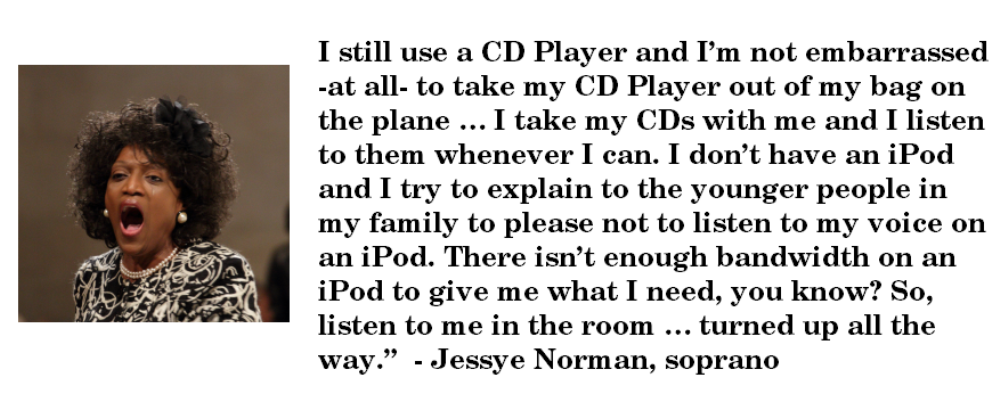
Jessye Norman was recently discussing whether or not she listened to an iPod. She said something that I think is very true when it comes to forcing opera into a teeny-tiny-little space:


Dumbing opera down, making opera more bland, making opera more "mainstream", shoving opera into a small box, simply cannot be the long term future of opera. It simply cannot. Opera deserves better. And, to be perfectly honest, audiences deserve to be given more credit.

Instead of dumbing opera down because some assume general audiences wont get it... we must educate them. Instead of making opera more bland because some are afraid the spectacle will drive them away, we must let it be grand and give them the opportunity to fall in love with it. If we don't, we are enticing an entire generation of audiences to fall in love with something that is not true opera.

Iyanla Vanzant said it best:
"When you don't show up as who you are, people fall in love with who you're not. Then when they find out who you are, that's when they leave."
Hojoto!

Tuesday, May 22, 2012

Peter Gelb to OPERA NEWS: critiques are not "in the best interests of the Met" - so, STOP IT.

Met's Peter Gelb - by Sara Krulwic h / NYT
The long arms of the Metropolitan Opera's sovereign general manager, Peter Gelb, have - again - slapped down a media source.

Yes ... again.

As you'll remember, the first slap from Gelb came in August of last year when Gelb's Met forced the shut down of the Met Futures blog that, since 1996, aggregated information (some gossip, some true) regarding potential upcoming casting-slash-season decisions from the Met. But, as a parting gift, the Met’s communications department offered him some CDs, which he accepted, and of course carefully spoke with him about the tone and content of his farewell post.

Last month, yet another slap from Peter Gelb came in the form of complaining to the leadership at WQXR about a blog post that called his leadership abilities into question. The powers-that-be at WQXR made sure the blog post was pulled.

And this time, it's OPERA NEWS Magazine.

Since I have been corrected on this subject previously, it is important for me to clearly state that OPERA NEWS - with it's circulation of 100,000 providing information on the Met's casts, broadcasts and glossy profiles of its star singers - is a publication of the Metropolitan Opera Guild, NOT the Metropolitan Opera. The Metropolitan Opera Guild is a guild formed for sake of fundraising for the Metropolitan Opera. As was pointed out to me - it is, in point of fact, a separate not-for-profit entity.

In addition to being a unabashed advertising and public relations vehicle for the Met, OPERA NEWS runs features on other opera houses, seasonal festivals and (a personal favorite of Yours Truly) performers of past eras. The In Review section of the publication runs critiques of performances from around the world by reviewers who are, on the whole, relatively respected and reasonably astute.

Here's the rub, though ... OPERA NEWS, the 76 year old, leading classical music magazines said on Monday that it would stop reviewing the Metropolitan Opera's productions - effective as of the June 2012 issue. While it is said that the decision was made by the magazine, it is understood by many to be a policy prompted by the dissatisfaction on the part of Gelb the Met over negative critiques.

Daniel Wakin reports for the NY Times:
The move came after a review in April took aim at the Met’s new production of Wagner’s “Ring” cycle — a hallmark of Mr. Gelb’s tenure that has led to a firestorm — and after a top Opera News editor criticized the Met’s direction in a scathing essay in the May issue.

Mr. Gelb said in an interview on Monday that the decision was made “in collaboration with the guild” but that he never liked the idea that an organization created to support the Met had a publication passing judgment on its productions. Worse yet, he said, is a publication that “continuously rips into” an institution that its parent is supposed to help.
SO, in other words, all was well while OPERA NEWS gave it's usual sugary-sweet reviews of the Met's productions ... but, as soon as the magazine which is published by a separate not-for-profit entity became critical, they get a smack-down.

Again, Daniel Wakin reports:
Opera News has reviewed Met productions continuously since at least the mid-1970s, [F. Paul Driscoll, the magazine’s editor in chief] said. While not frequent, negative notices have periodically made their way in, to the discomfiture of previous Met administrations. But no ban was imposed, at least in recent decades.

In the April issue, a review by Fred Cohn criticized the staging of
Götterdämmerung, the final work in the “Ring” cycle. The productions of the four operas, which finished their run this month and were directed by Robert Lepage, were the subject of much critical scorn, although they had many fans too. Mr. Lepage’s huge piece of machinery used for all the operas functioned as a lightning rod.

“The physical scale of Robert Lepage’s
Götterdämmerung may have been immense, but its ambitions seemed puny,” Mr. Cohn wrote.

An essay in the May issue by Brian Kellow, the features editor, may have spelled the end. It read, “The public is becoming more dispirited each season by the pretentious and woefully misguided, misdirected productions foisted on them.”

Mr. Gelb singled out the line in Monday’s interview. Such negative comments from a publication that is part of a Met support organization “certainly would not be in the best interests of the Met,” he said.
OH! I get it ... OPERA NEWS is now *only* to be an advertising and public relations vehicle from an in-house fundraising organization - NOT an outlet of independent journalism (not that it was really all-that-independent to begin with).

Clearly, OPERA NEWS is supposed to continue with it's glossy spreads on the Met's casts, broadcasts and star singers, while keeping the Met beyond reproach and being critical of everyone else. Did Gelb not stop to think that some criticism of the Met, and his leadership, worked well as an occasional counterbalance to the pages upon pages of blatant advertising?

I think Brian Holt, blogger at Out West Arts, said what is now on everyone's mind:
By eschewing work at the Met but continuing to publish reviews of other houses, the magazine and the Metropolitan Opera generally have cast a pall over their credibility if not their ethics.
'Tis sad, but true.

**UPDATE**

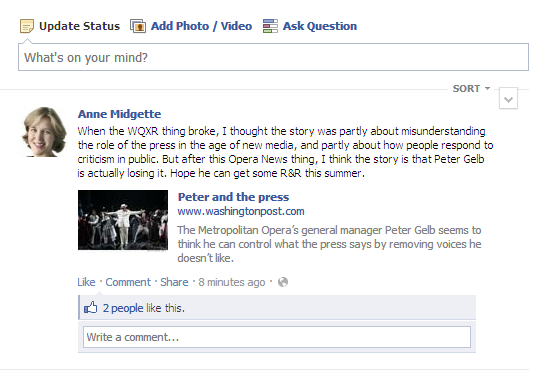
Our friend Anne Midgette at the Washington Post just posted a link to her article regarding Peter Gelb on Facebook - with the following commentary:

Wednesday, May 16, 2012

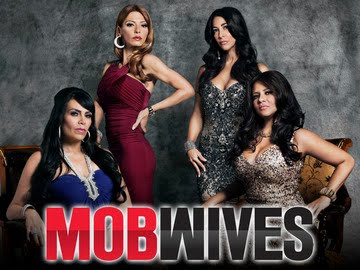
"Mob Wives" comes to the (satirical) opera stage

We all know that there are some times when a piece of information is released to the media in a tongue-in-cheek fashion. Such as when a California immigration-activist satirically suggested that illegal immigrants should chose "self-deportation" ... only to have the presumptive presidential nominee for the Republican party bring up "self-deportation" in a debate as though it were really a possibility.

Well, Chiclets - it appears that the same has happened regarding the news that VH1 is using their hit show Mob Wives as a basis for an opera. A fellow blogger - with whom we've had run-ins before - has taken a mole hill and turned it into an operatic mountain. VH1 is not putting Mob Wives on the operatic stage, as was reported - at least not physically. Although, to be honest, if they wrote the role of Big Ang as a bass baritone - which, clearly ... they should - Yours Truly might actually consider dressing in drag to play the role. Big Ang is absolutely hysterical.

From the VH1 Blog:
Mob Wives can be dramatic, even operatic at times (although this season, you could also compare it to a Greek tragedy with all the familial betrayal). But all that intense emotion is why we love it so…and why we love this new promo which premiered on Sunday night. Watch the video above to see the Mob Wives Opera play out in all it’s bobble-headed glory. Unlike Big Ang, we think you should stick around for this drama.

Mob Wives airs Sundays at 8 p.m. ET/PT.

Get More: Mob Wives 2

Tuesday, May 15, 2012

The Trailer has arrived for "Renée Fleming: A YoungArts MasterClass" on HBO

Last week, I brought you the news that RENÉE FLEMING: A YoungArts MasterClass, is set to air on HBO on May 28, 2012 at 6:00pm. Inspired by the hugely successful first season of the HBO MasterClass series, this Special Presentation will inaugurate the second year of the acclaimed Emmy-nominated program.

YoungArts MasterClass presents world-class creative artists who share their art and life experiences with small groups of young artists who represent a new generation of American talent. Each edition of the program highlights the importance of mentorship, which resonates in the arts and beyond, allowing this new generation of young artists to meet and work with legends, like Renée Fleming, in the fields they aspire to pursue.

La Diva Renée personally selected the four students from amongst numerous classical voice winners from YoungArts, the nation’s premier organization recognizing and supporting young artists. They include Sean Plumb from Los Angeles, attending the Curtis Institute of Music in Philadelphia; Chrystal Vanrell from Huntsville, Alabama, attending the Mannes School of Music in New York City; Aaron Casey from Houston and enrolled at the University of Houston; and, Samantha Hankey of Natick, Massachusetts, attending Juilliard in New York City.

The YoungArts program has honored more than 16,000 young artists with more than $6 million in monetary awards and facilitated in excess of $100 million in college scholarship opportunities. Alumni go on to become leading professionals in their fields and include actresses Vanessa Williams and Kerry Washington, four-time Tony Award nominee Raúl Esparza, Executive Director of American Ballet Theatre Rachel Moore, recording artists Nicki Minaj and Chris Young, musician Jennifer Koh, choreographer Desmond Richardson, and internationally acclaimed multimedia artist Doug Aitken.

I, for one, can not wait ... and after you watch this "official trailer", you'll feel the same, Chiclets. Trust. Once your done watching the trailer, head over to Facebook and make sure to click that little 'like' button.

Tuesday, May 8, 2012

Bright, shiny Pinterest

Pinterest... when I first heard about it, I have to say that it was not in a favorable light...
"It's the girly Tumblr..."
"It's where anorexic girls go for inspiration..."
"It's where DIY craft projects go to die..."
But, no matter how hard I tried, I couldn't get away from it. Virtually every website I landed upon had the tiny little button that beckoned me to "Pin it" - and, as I continued to spend more time with Pinterest, I noticed that it was quickly growing past it's triteness and into the new "bright, shiny object" of the social media world.

For those who don't have a clue what Pinterest is, let me start by clearing up something. It is indeed Pinterest... not PinInterest or Pinterested. It's Pinterest.

Now that that's cleared up ... Pinterest is a pinboard-style social photo sharing site that allows users to create and manage image collections. Users can browse other pinboards for inspiration, 're-pin' images to their own collections and/or 'like' photos. Pinterest's mission is to "connect everyone in the world through the 'things' they find interesting" via a global platform of inspiration and idea sharing. Pinterest allows its users to share 'pins' on both Twitter and Facebook, which allows users to share and interact with a broad community.

Launched in early 2010, Pinterest has gone from being one of the fastest-growing social networks to being the third most popular social network in the U.S. It comes up right after Facebook and Twitter, both of which are already known globally and have millions of users overseas. Pinterest is hoping to join them in the international arena.

Yep. I signed up.

I figured that I would pin things that are relevant to this blog ... well, let's just say Chiclets, my boards on Pinterest have definitely expanded. I've gone from old-school opera, inspiration and theaters to include old-school Hollywood, sacred spaces, 2012 presidential campaign images and even a style board where I can study up and hone my personal style. Trust: I need all the help I can get in the style department.

The more I explored, the more I realized that there are quite a few of us "opera-types" on Pinterest already. Here are just a few:
Royal Opera House
Metropolitan Opera Guild
Opera San Jose
The Atlanta Opera
Central City Opera
LA Opera
London Symphony Orchestra
Detroit Symphony
Nevada Opera
I encourage you to check it out ... start by signing up and following Yours Truly! But, be warned ... Pinterest can suck you in and before you know it, you've gone from zero to 907 pins.

Happy Pinning.

Thursday, March 15, 2012

Now, there's an app for this, too? Met Opera on Demand

Alright, I'm going to come clean with all of you - so, fasten your seat belts ... Yours Truly does not own an iPad.

I know. I know. How can one call themselves a blogger in this day-and-age without owning an iPad?

What's worse? (Yes, it gets worse) I don't even have an iPhone. I walk around New York trying to conduct my life on a BlackBerry. When I had the chance to get an iPhone a year and a half ago, I chose not to. I mistakenly thought "Meh, I don't need all of that... straight forward function. THAT'S what I need." I definitely subscribed to the notion highlighted in the latest BlackBerry TV spots "for those who need tools, not toys."

I was so wrong.

So, now I'm stuck waiting until October when my inane and nearly useless AT&T contract / BlackBerry comes up for renewal. Le Sigh. It's a long time until October. No iPhone, no iPad - I feel like I'm standing still while everyone else races past me on the social media race track.

Well, just like rubbing some salted lemon juice in an open flesh wound, the Met has released a brand new iPad app - Met Opera on Demand. The app allows unlimited streaming access to video transmissions from the Met’s Live in HD series [yawn], plus hundreds of historic TV and radio broadcasts. Yes, you read it correctly - no need to adjust your glasses - plus hundreds of historic TV and radio broadcasts.

iPad Screenshot of Met Opera on Demand
The free app, available for download from the App Store, will give opera fans around the world mobile access to high-quality audio and video streams of hundreds of performances from the Met’s 81-year broadcast history. New content will be added monthly, including recent Live in HD transmissions featuring the well known singers of today’s opera world. Live in HD titles will be added to the service two to three months after their premiere in movie theaters.

A subscription is required to access streaming content, with plans beginning at $14.99 a month.

In it's initial offering, 44 selections will be available from the company’s Live in HD series, including the behind-the-scenes intermission features. The streaming service also allows users access to historic telecasts featuring stars like Luciano Pavarotti, Plácido Domingo, Joan Sutherland, and Leontyne Price. The video library includes historic performances, such as a 1979 production of Don Pasquale starring Beverly Sills or a 1998 Le Nozze di Figaro telecast starring Renée Fleming, Cecilia Bartoli, and Bryn Terfel. All videos include English subtitles and many offer alternate titles in French, German, Italian, Portuguese, Russian, and Spanish.

Also, for those of us who realize that in order to know where we're going, we have to know where we've come from ... More than 250 audio performances from Met history are available through the Met Opera on Demand app. Digitally remastered audio streams, beginning with a 1936 performance of Wagner’s Götterdämmerung, starring Lauritz Melchior, are available.

And get this, Chickpeas... The Met Opera on Demand app includes social sharing capabilities for Facebook and Twitter and provides users with the ability to create favorites lists.

So basically, it's done - I now have to breakdown and figure out a way to get my hands on an iPad. More to come...

Tuesday, February 28, 2012

A rant: Katherine Jenkins, opera star?

So, when Yours Truly was a senior in high school, I campaigned for the office of Senior Class President. I ask you: does that make me a politician?

Every morning when our girl is getting ready for school, I do her hair before she leaves. I ask you: does that make me a hair stylist?

Sometimes, I make dinner ... even for dinner parties. I ask you: does that make me a chef or caterer?

If you answered 'no' to all of the above questions ... you win! TELL THEM WHAT THEY'VE WON, BOB!!!

Now, this morning, the Dancing With the Stars cast of stars contestants was revealed. And, I'm sure we all know that I'm going to be placing my votes behind Gladys Knight and Sherri Shepherd ... I mean, let's be frank: Melissa Gilbert? Gavin DeGraw? Jaleel White.... URKEL? My eyes were rolling so hard they almost got stuck facing the back of my head.

As I was working my way down the list... I came upon "Opera singer Katherine Jenkins, 31".

Then, I saw on another news organization's list, "Katherine Jenkins, opera star".

Wait one-hot-second ... back up the truck - OPERA SINGER Katherine Jenkins? Katherine Jenkins, OPERA STAR?

Thus begins my head spinning around like Regan MacNeil's.

This is so WRONG - and, let me break down why:

In order to be an opera singer, you have to sing opera. Having performed a number of operatic roles in my life, I can confidently say that, while I'm not currently contracted to perform opera, I am an opera singer. Why is that? Because I have trained and have performed operatic roles ... on stage ... in front of an audience. I am a singer who has sung operas - an opera singer. If someone called me tomorrow and said, "James, we need you to come and sing [insert bass role here] ..." I could do it.

In order to be an opera star, you have to sing opera ... and not just a little aria here and there. You have to be professionally starring in leading roles in major opera houses on an ongoing basis.

Correct me if I'm wrong - and, I know you will - Katherine Jenkins is none of the above. She is another one of those people who has an instrument which is manipulated to sound like it's open-throat singing -- Charlotte Church, poor little Jackie Evancho, of course Andrea Bocelli ... they're all in that boat. Although, to be honest ... even Bocelli has sung at least ONE operatic role.

Many times, these singers are called "classical crossover artists" - which, in itself, is quite a stretch. While I understand that "classical crossover artist" is harder to say that "opera singer", I do find it very misleading for people to call these singers "opera singers" - when clearly they're not. Regular Joe Q. Public doesn't truly understand that they aren't opera singers. I get that. And saying they are opera singers gives them a certain classy appeal. But, as an opera singer, I take offense when I mention to someone that I am an opera singer and they ask me, "You mean like Jackie Evancho... or Andrea Bocelli?"

Uh ... no.

But, how is Joe Q. Public going to know the difference when they're told that people like this Kathy Jenkins are opera singers?

And, don't even get me started on Bocelli. Remember after the 2010 GRAMMYS when I ranted about Bocelli being introduced as "legendary opera star Andrea Bocelli"? I said it then, and I maintain my position: his voice is faux. It's faux opera - it's fauxpera. And, it's true that some people wonder how I can like Il Divo and not like Bocelli - they're all "classical crossover artists" who are making their living in pop. Here's the difference - Il Divo's handlers (a.k.a. Simon Cowell), know where their place is - they're the new generation of Popera. And, while 3 out of the four members of Il Divo are actual opera singers (aka: having sung operatic roles on stage), they don't claim to be opera stars or "legendary opera singers".

Back to Kitty-Kat Jenkins ... is she a singer? Yes. Is she an opera singer? Hardly. Yes, she can haul out an aria (albeit in a much different key than the original) - but, again, that doesn't make her an opera singer. Let us not forget that a certain Aretha Franklin sang "Nessun Dorma" at the GRAMMYS in the place of an ailing Luciano Pavarotti. I think we can ALL agree that Aretha Franklin should stick to being the Queen of Soul ... And, I think Jenkins should stick to being ...

"Welsh singer, Katherine Jenkins".
Related Posts Plugin for WordPress, Blogger...