Wednesday, September 29, 2010

And they're off ... The MET opens with Das Rheingold

The reviews are in for the Metropolitan Opera's 1st installment of it's new "Ring"...which was also the season opener.
- Mike Silverman | AP:  "The 'Ring' has arrived, all 90,000 pounds of it. And, for the most part, it's worth its weight in gold.

The object in question is the most talked-about set in years at the Metropolitan Opera, a high-tech machine designed by Canadian director Robert Lepage for his new production of Richard Wagner's 'Ring' cycle.

After years of construction and months of rehearsal, it finally went on public display Monday night as the company opened its season before an enthusiastic gala audience with the first installment in the four-part work,
Das Rheingold." 

- Richard Ouzounian | The Toronto Star:  "The extraordinary thing about Robert Lepage’s production of Das Rheingold, which opened the Metropolitan Opera season on Monday night, is how it manages to be traditional and revolutionary at the same time.

...Robert Lepage and Richard Wagner: a marriage made in operatic heaven."
 

- Manuela Hoelterhoff | Bloomberg:  "The prospect of a new 'Ring' at the Metropolitan Opera has sent opera nuts into a state of hyper-excitement for months on end.

This may be the first production in opera history generating a stream of bulletins on the weight of the set.

Yes, the set, not the soprano.

For this unusual obsession, we thank Canadian director Robert Lepage. The multimedia wizard, best-known for his Cirque du Soleil extravaganzas, was hired to give Wagner’s four-opera epic ... a new dimension of edgy fabulousness.

Weighing in at 45 tons, the set was finally unveiled last night as patrons squeezed into the theater, paying as much as $5,500 a seat (this did include a champagne dinner ending with ‘Smores) for
Das Rheingold." 
Ok ... so, someone obviously forgot to send Manuela the memo. Here it is Manuela: jokes about weighty sopranos do nothing but make people grumble and roll their eyes repeatedly. Whomever told you it was ok to put that into your review - yea, not so much.

So, those reviews all speak relatively well to Das Rheingold. There is one jeer that I found and I would not be doing my duty if I didn't bring that to you as well.
- Arthur Kaptainis | Montreal GazetteYay, boo, yay, boo, yay, boo. There have been many contentious first nights in the annals of the performing arts, and the opening of the 2010-2011 season of the Metropolitan Opera will go down as one of the notable yay-boo feuds of our still-young century.

I say the boos have it. Not that any could be directed at the stunning cast, or the superb orchestra, or the splendidly coherent podium leadership of James Levine, who was returning after widely-publicized surgery and still walking with difficulty. All of the otherwise-oriented expression was reserved, and rightly, for Robert Lepage and his technical team from the North.

To be fair, we should remember that this new Met production of Wagner's
Das Rheingold - the preliminary evening of the four-part 'Ring' - was talked up to the high skies as the inauguration of the new high-tech operatic age. Which is why the indifferent sequence of mid-tech anticlimaxes on offer Monday night seemed so grievously disappointing.
I don't know, Chickpeas ... it seems like a success to Yours Truly, too. Even though the set did breakdown at the end of this opening night show. But, nonetheless, when you pair this season's opener with last season's - the much boo and hissed Tosca, you can't help but let out a sigh of general relief.

[SIGH!]

It has been said that as the new season opens, so does what seems to be a new electronic age in Opera. No, I don't mean amplification - thank God. But in this case, the new set - which is so huge that the stage had to be reinforced with steel - is full of all kinds of fantastic little tidbits of technology. But, with technology comes somewhat of a gamble because you're never guaranteed that it will work well. Zachary Woolfe describes the set for his New York Observer piece titled The Met's Bridge to Nowhere thusly:
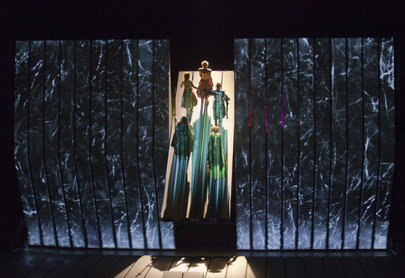
The central element of the production is something the Met and the press have taken to calling "the machine"-a long row of loosely L-shaped planks, which can see-saw individually and also rise and fall as a unit, creating many possible configurations. Moreover, the entire structure functions as a projection screen, particularly for the interactive, digital projections in which Mr. Lepage and his team specialize, like a hill of pebbles that gently roll down as Alberich climbs up and a small circle of flames that accompanies the fire god Loge when he walks. There are times when Mr. Lepage's vision is elegantly realized: The opera opens with the machine undulating mesmerizingly as the River Rhine, and the gods' journey down a treacherous staircase to the mines of Niebelheim has epic scope.
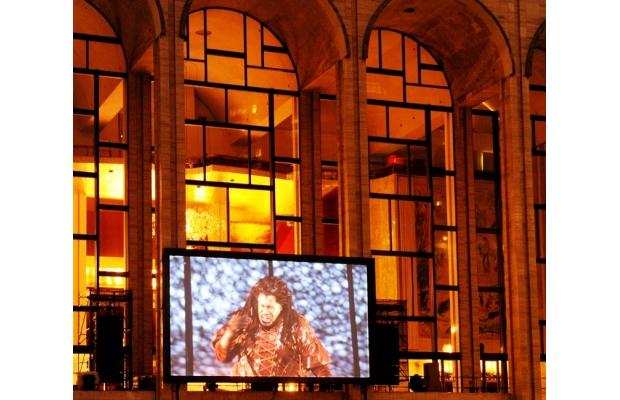
The set cost a pretty penny, but was money well spent as this opening night was not only seen by a full house, but free live streams were sent to 3,000-plus people in Lincoln Center's plaza and another 2,000 or so in Times Square. This coupled with the fact that this production opens the MET's season of 12 live broadcasts ... Two things are perfectly clear: the MET is using a whole-lotta technology and General Director Peter Gelb is not afraid to take a gamble on it.

Why would he be afraid? The live broadcasts were certainly a technology gamble that paid off for the MET. Five years ago when all of this broadcast hubbub began, there were definite grumblings at Gelb’s pet project. But, as the Met continues to build it's electronic brand, which consists of the high-definition video broadcasts, live and satellite radio, video-on-demand and DVD sales, the critics have been silenced.

Gelb understands that in this trying economic time, the way to increased income for anyone is by way of multiple streams. So, although full priced ticket sales are up to 85% of capacity from 76% four years ago, ticket sales aren't enough. You need revenue to come in from every nook and cranny possible and the electronic brand that Gelb is meticulously building provides a generous portion of that.

As the crown jewel of the MET's electronic brand, the company’s nine live opera broadcasts sold 2.4 million tickets in some 40+ countries last season. The MET made an $8 million profit which helped cover a general operating deficit.

Not too shabby, hey?

Yet the notoriously ego-centric Gelb told John Terauds of the Toronto Star: “You can’t run an opera house and be cocky. It’s a bad combination.” Although let's be honest, he runs the most famous opera house in the world - I'd cut him some slack if he wanted to be a little egotistical.

As for the future, Terauds reports:
Gelb speaks modestly of his plans for the next five years. “I’m continuing to keep my fingers crossed,” he says. “The only thing we can do is play the odds by bringing in great directors and singers, tinker with the repertoire and introduce new works.”

Technology is not an end, but a means. “I hope it works by making good opera.”
Tinker away, Gelb... and by the way, let's go ahead and get that set situation worked out - shall we?

Tuesday, September 28, 2010

AZ Opera Orchestra strike authorization approved

I've just received a tip that the Arizona Opera Orchestra Musicians Association's (AZOOMA) strike authorization has been approved. I've not confirmed it as of yet, but check out the comments in my post below.

Domingo is leaving his post at Washington National Opera

Our friend Anne Midgette at The Washington Post reported yesterday:
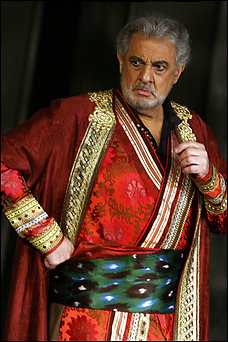
Plácido Domingo [R.], the tenor, baritone, conductor, and opera administrator extraordinaire, said Monday that he will not renew his contract as general director of the Washington National Opera when it expires in June, 2011.

His departure is not entirely a surprise -- Domingo has long been thought to be chronically overextended. But it also means that the company is left without a marquee leader, its most recognizable brand, at a time when nearly every detail of the WNO's future is open to question -- most importantly, whether it will remain autonomous or merge with the Kennedy Center.
For more, check out Ms. Midgette's article.

Monday, September 27, 2010

Arizona Opera Orchestra has voted on strike authorization - UPDATE

As we reported here last week, the Arizona Opera Orchestra Musicians Association (AZOOMA) has filed an unfair-labor-practice charge against the opera's management, claiming that General Director, Scott Altman, sidestepped the union's negotiating committee to lobby the opera's position directly with musicians. In its complaint to the Labor Relations Board, the Arizona Opera Orchestra Musicians Association contends Altman contacted union musicians - current and former - via e-mail.

Now, you'll remember that Arizona Opera has given the ol' "shake down" to the chorus during it's AGMA negotiations - almost giving the ax to a core group of singers from it's Tucson roster. At this point, Arizona Opera trumpeted from far and wide that they had wrapped up negotiations with AGMA regarding the chorus. "Arizona Opera announced today the successful conclusion of negotiations with the Arizona chapter of the American Guild of Musical Artists (AGMA-AZ)".

There is no box, wrapping paper and bow for AZOOMA, however. A source reasonably close to the negotiations writes the following:
It has become apparent that with the new management has come a new vision. In short, this vision involves drastic cuts and unrealistic expectations. Their focus is on bottom line figures.

In response, the musicians met last night – teleconferencing from over 5 different cities – and agreed to take a strike authorization vote.

If approved the strike authorization gives the negotiation committee the power to call a work stoppage – if it is deemed necessary. This is an excellent fail-safe mechanism which guarantees that the musicians have the final say on calling a work stoppage.

If it passes, this measure gives the negotiation committee the power of if and when. If it is necessary, the committee will say when the strike happens.

The results of last night’s AZOOMA vote are not available yet. Because the Arizona Opera Orchestra has members scattered in various cities, the vote tallying will take some time.
It looks like Arizona Opera might find itself without an orchestra in the pit - which makes producing opera impossible. I wonder how *that* will effect Arizona Opera's bottom line.

**Update**

Due to the ongoing negotiations, I have removed the updated material until the negotiations are complete.

Wednesday, September 22, 2010

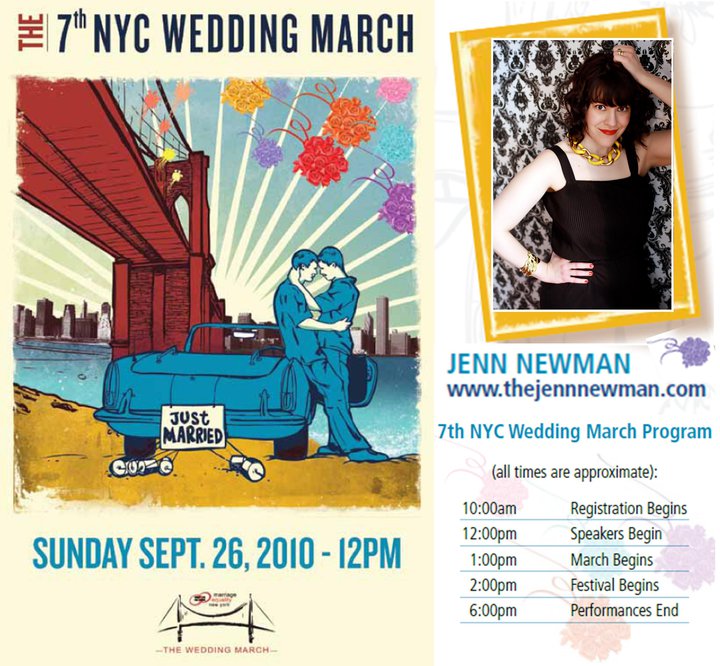
Marriage Equality New York - 7th NYC Wedding March


Come see fantastic speakers, march with us and be entertained at the festival. In addition, you can hear Jenn open the March by singing our National Anthem as well as performing some of her favorites at the post-march festival! Register to march by visiting www.meny.us/march or donate by visiting Jenn's page: tinyurl.com/thejennnewman. Hope to see you there!

Musician Labor Disputes: Arizona Opera Edition

Things are (yet, again) tense at Arizona Opera.

"We've made a huge sacrifice, and we're going to see what the company is going to do with it," says John Cleveland, Arizona Opera's union steward for the American Guild of Musical Artists which is the union that covers the chorus members. "Either the company is going to get better, or the company will be gone."

Woops. That's a pretty strong statement!

You see Ladies and Gents, Arizona Opera - the resident opera company of both Tucson and Phoenix - is butting it's head with the unions. I know, you're SO shocked, aren't you? [insert obligatory eye roll here]

The Arizona Opera Orchestra Musicians Association has filed an unfair-labor-practice charge against the opera's management, claiming that General Director, bass baritone Scott Altman, sidestepped the union's negotiating committee to lobby the opera's position directly with musicians.

Labor issues seem to be going around like the plague in Arizona. I remember a certain issue not to long ago with the Phoenix Symphony.

In its complaint to the Labor Relations Board, the Arizona Opera Orchestra Musicians Association contends Altman contacted union musicians - current and former - via e-mail. According to Nathan Mitchell, who chairs the musicians' negotiating committee, that violates the federal National Labor Relations Act.

"We've seen the e-mails; we know that they were sent to everyone in the orchestra," Mitchell told the Arizona Daily Star. In addition, Mitchell says that former and substitute musicians and some who are auditioning for the opera also were sent e-mails.

Now, who in their right minds - if we can say "right minds" - violates the National Labor Relations Act via something that is as traceable as EMAIL? I ask you, Chickens... WHO?

It should be noted that the union musicians and the opera have been negotiating a new contract since June... yes, since JUNE! Union contracts expired June 30.

What's the rub, you ask? Good, because you know I'll tell you.

According to the Arizona Daily Star:
The orchestra has 52 musicians from Phoenix, Flagstaff and Tucson. They rehearse in Phoenix for performances mounted there and in Tucson, and many spend the summers performing in festivals around the world.

The musicians said the opera has offered them a contract that maintains their current $101.92-per-service fee rate. A service is defined as a three-hour rehearsal or performance. The opera, however, is proposing the service time be extended by a half-hour with no additional pay, Mitchell said.

Management also is proposing that the musicians pay 60 percent of their travel expenses between Tucson and Phoenix, lose 75 percent of their daily meal per diem and pay for half the cost of their hotel rooms when they are outside their home city, Mitchell said.

"It's basically going to work for free or not," said Cindy Baker, the orchestra's principal second violinist and a member of the negotiating committee. "It seems to us to be sort of extreme."

The expense cuts are tantamount to a dramatic pay cut, the union contends.

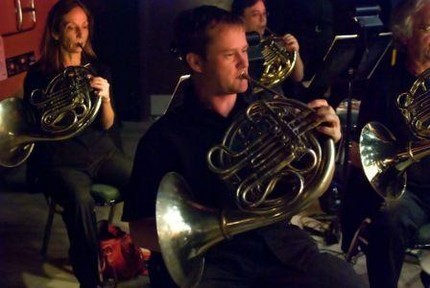
"It ends up ... coming out to making $31 or something like that for the whole weekend," said Mitchell, who lives in Phoenix and plays in the horn section. "I enjoy doing it, by all means, but I can't lose money playing a gig."
Of course, when asked about the issues between the company and the player's union, Arizona Opera had no comment, except to pivot the discussion with a Press Release:
Arizona Opera announced today the successful conclusion of negotiations with the Arizona chapter of the American Guild of Musical Artists (AGMA-AZ) and the International Alliance of Theatrical Stage Employees (IATSE-Local 336-Phoenix). Fruitful discussions between the Company and the Unions resulted in new three-year collective bargaining agreements, ratified by AGMA-AZ and IATSE- Local 336, which run through June, 2013.
The Press Release goes on with one self-congratulatory pat-on-the-back after another. Then, the release ends with an "OH! By the way...." :
Arizona Opera continues to negotiate in good faith with its Orchestra members – the Arizona Opera Orchestra Musicians Association (American Federation of Musicians).
Seriously?

As for the pivot in the conversation - "Arizona Opera announced today the successful conclusion of negotiations with the ... American Guild of Musical Artists (AGMA-AZ)". Successful to whom? Successful in that the talks are over and a contract is signed, yes. Successful for the chorus members? Yeah, right.

You see, Arizona Opera recently closed its Tucson production operations and has moved everything to Phoenix. According to John Cleveland, part of this moving plan was to release some of its veteran Tucson choristers from the roster.

Thanks for playing ... bye, bye!

Not so much, though - these valiant and extremely loyal choristers were spared.

Cleveland told the Arizona Daily Star: "...everyone who has sung in the past who lives in Tucson has been rehired, except for the ones who were not available this season. That was one of our big objectives, to preserve the Tucson presence in the chorus. And we achieved that. . . . They are a huge artistic asset to the chorus."

AGMA - which, again, is the chorus' union - also got Arizona Opera to agree to allow choristers to rehearse in their home cities. Early on, the opera was going to require singers from Tucson to travel at their own expense to Phoenix for rehearsals, Cleveland said.

For those who don't know, the distance between Tucson and Phoenix is approximately 2 hours by car. Usually, the Opera Company charters buses for company members to travel to and from.

Traveling at their own expense would have, as in the case of the Orchestra Members, broken chorus members because, as Cleveland pointed out, the chorus has not received any significant pay increase in several seasons. The last raise was a mind blowing 1.5 percent bringing chorus pay to $14.38 an hour for rehearsals and $138.23 per performance, which averages three hours.

After all of this, here is what General Director Altman (R.) had to say:
“I applaud the extraordinary leadership of AGMA-AZ and IATSE- Local 336 in bringing to a conclusion these very crucial negotiations,” said General Director Scott Altman. “Arizona Opera is poised to take an exciting step forward. In this, our 40th Anniversary Season, we begin with a new business model for how the Company operates. I am pleased that these two key Unions are partnering with us as we face the challenges of this new era. I applaud the foresight of the Unions in realizing that the economic and professional well-being of their members is directly associated with the artistic and financial health of Arizona Opera, and it was in this spirit that the negotiations were conducted. I must also note that our Arizona Opera administrative staff has also stepped up in a major way. They have absorbed some severe cut-backs and continue to function at a very high level because they, too, understand what is at stake. Ensuring the survival of professional opera in Arizona is truly a joint effort, and all of us have an important, but difficult, role to play.”
In other words, take note Orchestra Musicians Association. The other unions rolled over - why wont you?

MANY THANKS to my eyes an ears back in Arizona. You know who you are and so do I - that's how it'll stay.

Friday, September 17, 2010

Happy Birthday to Jessye Norman

I must admit to you, Friends ... I feel a little sheepish.

I was so consumed (and rightly so) with this last Wednesday, September 15th being the birthday of my better half -- the amazing, the awe-inspiring, the so-talent-your-head-could-spin, The Jenn Newman -- that I was remiss in reporting on the birthday of another Diva.

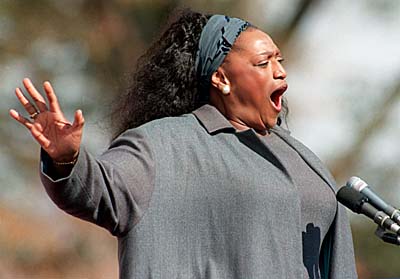
On Wednesday, Our Lady of Grand Buccal Cavities, Jessye Norman turned 65. That's right Ladies and Germs, the lady who's mouth seems to have been the original model of the flip-top-head, turned 65.

What a better way to celebrate than to sit back and watch this Diva discuss her life and art. (You'll see what I mean about the flip-top-head. Make sure to turn up the sound though, it's a little muffled.) Enjoy!


Thursday, September 16, 2010

A Moment In Time - Maria Callas

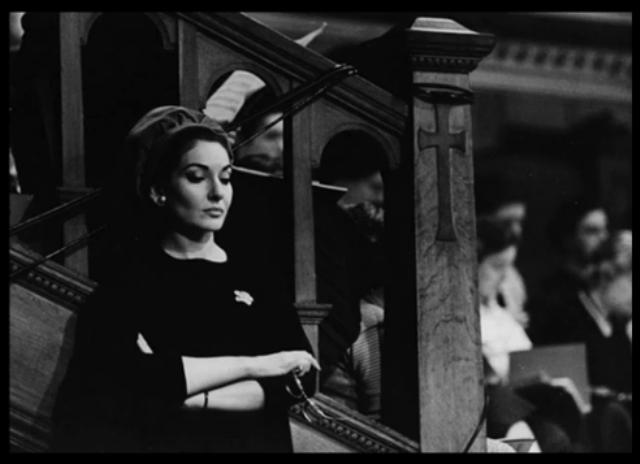
On this date in 1977, soprano Maria Callas - perhaps Opera's most mainstream celebrity of the pre-Pavarotti world - died in Paris. She was only 53 years old.

The cause of death was attributed to a heart attack - although some will report it as heart failure. If you talk to famed opera and film director Franco Zeffirelli, you'd probably get a different story. In 2004, Zeffirelli made what many consider a bizarre claim that Callas had been murdered by her confidant, Greek pianist Vasso Devetzi, in order to gain control of Callas's estate - which was estimated to be about $9M.

Truth be told though, it seems that Maria may have, either accidentally or not, offed herself by overdoing it with the drug Mandrax (methaqualone) which was a common sleeping aid at the time.

I think many would love nothing more than to make her death more sensational than her life - as if getting her ashes stolen from Pere Lachaise Cemetery isn't sensational enough.

PS and FYI: They were later recovered and scattered in the Aegean Sea.

As I've said before, those who are counted as legends seem to leave us all too early. Perhaps that is one of the things that contributes to the legend. No matter who you ask, Callas was indeed a legend - at least an operatic one - because of her artistry, her relationship with Aristotle Onassis, her temper, her all-too-public decline and her larger-than-life persona.

The legend aside, we can still get lost in her artistry thanks to the beauty of YouTube.


Monday, September 13, 2010

Fashion Week at Lincoln Center and Lela Rose

As many of you have seen by my recent tweets, I was at Mercedes Benz Fashion Week yesterday to see the Lela Rose show.

Having never been to anything like that before, I did what I always to in new situations, I acted like a sponge an soaked up everything.

Now, it comes as no surprise to most that I tend to take my time in processing things. I'm not a guy who shoots from the hip, but rather I take my time to look at a situation from all (ok, most) angles and *then* I'll come out with guns ablaze.

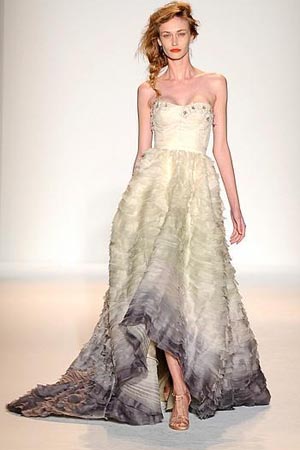
Here's what I've process so far... Not knowing enough about fashion and what's on trend or what's not, (read: I don't want this to pop up in someone's Google Alerts only to have them read it and howl in utter hysteria.) I will say only this: the Lela Rose line was simply stunning. Take a look at the picture if you don't believe me.

As incredible as the line was, I left the show thinking about something bigger than that. I find it extremely appropriate that Fashion Week moved to Lincoln Center and not just because Fashion is Art and Art is Lincoln Center ... yea, yea, yea ... we've heard that a million times before.

Here's why the appropriateness is so extreme - The designers who showcase their work in these shows go through months and months of blood, sweat, tears and then, some more blood and sweat ... and probably more tears. It all culminates into 20 minutes of creative purging - A.K.A the runway show. Then, they wait. People either buy what they're selling or they don't. Plain and simple. If people do buy- they're back to the drawing board to create more clothing as well as the next line.

Lather, rinse, repeat.

It's not unlike Opera, Orchestra, Theater or Ballet if you think about it. We work for months and months on our audition materials (not to mention the years of prep before hand), we show up and have 10 minutes of creative purging - A.K.A. the audition. Then, we wait. People either buy what we're selling or they don't. If people do buy- we're back to the drawing board to learn a new role, piece of music or dance routine for another performance.

Again ... lather, rinse, repeat.

Fashion is an ever changing, ever present and ever flowing venue of creative output. The process through which that creative output comes to be is something that we all have in common; the preparing for the preparation, the preparation, the execution, the waiting and the moving forward. Why wouldn't that belong at a place like Lincoln Center - surrounded by the best of the best in Opera, Orchestra, Theater and Ballet? Not gonna lie to you Friends... to me, it's much more appropriate at Lincoln Center than it was in the middle of a park.

But truly, who am I to judge fashion?

PS - Lela, I loved the music at the show. My daughter sang the opening song over and over again last night. There was also lots of prancing up and down our hallway in various forms of dress up... she was inspired.

[Photo: one of Jenn's faves from the Lela Rose show.]

Wednesday, September 8, 2010

Baltimore's Lyric Opera House gets a new -and much longer- name.

According to various sources, the Lyric Opera House in Baltimore will be renamed for the former owner of the Baltimore Ravens and his wife. The generous couple gave $3.5M to the theater's building campaign.

Besides the Modells' donation, the Lyric's $12.5 million campaign received funding from private donations and public bonds. But, indeed it will be the Modells that have their names on the theater - Patricia & Arthur Modell Performing Arts Center at The Lyric.

Could they have perhaps just called it the Modell Opera House or something like that? I miss the days when class and humility came with major donations. Patricia & Arthur Modell Performing Arts Center at The Lyric is just too much. Maybe it should be shortened to PAMPACATL?

Anyway, the money given by the Modells further ensures completion of extensive renovations to the 2,564-seat theater, which was home to the now-defunct Baltimore Opera Company, a tenant of the Lyric for five - yes, FIVE - decades. The improvements to the stage area will offer possibilities for elaborate productions of a variety of works. The renovations are scheduled for completion by the fall of 2011, when a staging of Verdi's popular opera La Traviata will be presented by the Lyric.

Jim Harp, Patricia & Arthur Modell Performing Arts Center at The Lyric's director of opera and educational activities tells the Baltimore Sun that the sets for La Traviata next year are coming from the Lyric Opera of Chicago and are "as opulent and beautiful as you will see at any theater in the world. We would never have been able to accommodate them before."

So, this question bares asking ... again ... where were all of these donors with all of this money when Baltimore Opera Company needed it in order to stay in business? Perhaps the Patricia & Arthur Modell Performing Arts Center at The Lyric wanted to be the reigning opera producer in Baltimore.

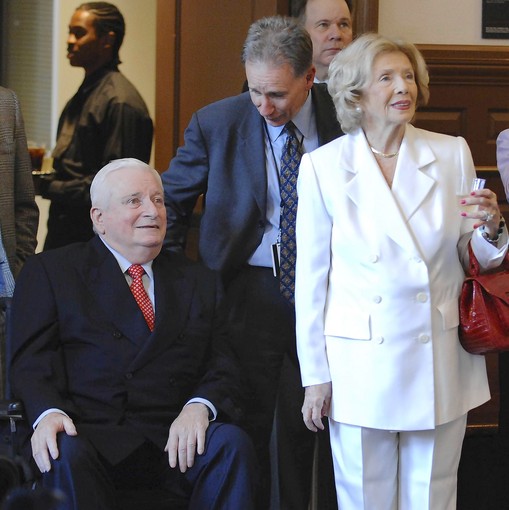
[Photo: Art Modell and his wife Pat. By Elizabeth Malby, Baltimore Sun)

Wednesday, September 1, 2010

Another Favorite Clip - Ah! Quel Furore

Everyone loves a good Mad Scene, no? Come on ... you know you love it when a singer runs around the stage having a melt down like Sally Field in the funeral scene of Steel Magnolias.

Keeping in that motif, this installment of Another Favorite Clip is dedicated to the art of the Mad Scene - AH! Quel furore!

Related Posts Plugin for WordPress, Blogger...