Cosi fan Tutte is a show with which I have spent a considerable amount of time.
Early in my days as a singer, I was assigned to cover the role of Don Alfonso with a small company in the Northwest. This particular production was set at a seaside resort and it stands out in my mind for a couple reasons. One of which was that our Fiordiligi was six months pregnant - which ended up to be somewhat hide-able with the period "Empire Waist" gowns that were chosen by the producer. The other thing that stands out to me during this production - and by 'stand out' I mean that it causes me to both laugh and wince at the same time - was that during the Fiordiligi, Dorabella and Don Alfonso trio "Soave sia il vento", the characters were placed at a golf driving-range. Can you imagine? Well, it's worse than you think ... Yep, while singing this gorgeous trio, the singers used golf clubs to whack ping pong balls over the heads of the orchestra and into the audience.
Now, let me know pause for a moment so you can fully grasp that visual.
A few years later, there was my tenure as a young artist in a program that had, among various educational shows available, Cosi fan Tutte - in English. Not just one version, either. Oh, no... there were two versions. There was a 45-minute "Mini Cosi" and a 90-minute version - both with spoken dialogue in place of the accompanied recitative. But that's not all folks. In these Cosi you could have your choice of either English dialogue, or because it was in San Diego, there was also the spoken dialogue in Spanish. This production was set in Italy with set pieces which were cleverly painted different colors on each side and could rotate or move into various formations ... not unlike a Rubik's Cube ... all at the hand of Despina and Don Alfonso.
I think we calculated that we sang 220-ish performances of Cosi that season.
And the last time I was with Cosi fan Tutte was in South Florida singing it for Francesco Pace, founder of LA Opera. From Pace, I learned that you can put a new production on it's legs in less than two weeks, sing two performances and go home. Certainly fun but, I wouldn't recommend that compressed of a time frame.
Yes, many companies trot out Mozart's operatic setting of Da Ponte's gem either because it's relatively easy to transform and update, or because of its small cast list, it can seem easily castable. Please note: it can *seem* easily castable.
This last Thursday night, I had the opportunity to head to New York Opera Exchange's updated version of Cosi fan Tutte. Being politically minded, I was intrigued with the idea that the production took place on Wall Street as a play on the 1% vs. #Occupy Movement. Additionally, in their first full season, the young New York Opera Exchange is on a mission to create performance opportunities with orchestra for young emerging artists who they surmise to be on the cusp of professional breakthrough.
Why wouldn't I want to see this Cosi, right? It's a politically minded Cosi supporting young artists.
Now, let's break it down: Mozart's music in Cosi is notorious for being deceptively difficult for the singers. Not to be taken lightly, it's a show that can either soar to gorgeous musical heights or fall flat. Many times, productions compensate for the lack of musicality by employing "smoke and mirrors" tactics or by pumping up the staging with copious amounts of frenetic action.
From the first few out-of-tune chords provided by the orchestra ... well, let's just say I was bracing for impact ... my seat-back and tray table were in their upright and locked position and I was looking for the oxygen mask to fall from the bin above my head. I thought the plane was going down shortly after takeoff.
Once the brief overture was complete, I settled into my metal folding chair and watched as the action began.
Two successful Wall Street types appear in their company gym and being feigning their work out. Let's be honest, this is really quite realistic given the physical-shape of many Wall Street types. Anyway, confidently asserting that their lovers with be eternally faithful are the naive Ferrando - played by the company's Artistic Director Justin Werner, and Guglielmo -sung by baritone Joseph Beckwith. Beckwith's robust voice took a little time to warm up - which is not uncommon for larger voices. Throughout the show Beckwith sang the difficult music with a measured finesse - but, about three quarters of the way through, he gave up fighting with the overpowering orchestra and sang with the throttle down until the end.
Of course, the gents are challenged by their cynical boss-slash-friend, Don Alfonso, and all agree to Alfonso's bet of substantial proportion that the women will not remain faithful. Sung by bass baritone, Brad Baron, Don Alfonso was a definite highlight in this production. Baron drew from his Gilbert and Sullivan experience to deliver dialogue with a consistent and committed intent. On the whole, Baron sang with a balanced richness and youthful vitality that worked quite well given the concept.
The unsuspecting lovers, co-workers and former sorority sisters, Fiordiligi and Dorabella, are enjoying a morning coffee on the outdoor patio of Starbucks when Alfonso approaches. The ladies are quickly duped when Alfonso reveals, in true histrionic fashion, that their men have been transferred to their firm's Chinese branch. And so, it begins...
Back in the office, Dorabella flies into an inconsolable fit. In this case, the quirky and fickle Dorabella was sung by lyric mezzo-soprano Abigail Levis. I know it's cliche to say - especially for someone reviewing a show - but, there are no other words to use: Levis stole the show. Her singing was consistently sumptuous and brilliant - reminiscent of a young Jennifer Larmore - while her portrayal of the character displayed comedic timing that was spot-on, giving us a Dorabella that was comically lovable. I can't wait to see more from her.
Don Alfonso's Administrative Assistant - Despina - can't help but get into everybody's business. Making fun of the ladies utter misery, Despina, prudently and purposefully sung by soprano Amanda Chmela, suggests that they suck it up and have fun while their guys are away.
Enter two Occupy Wall Street protesters - which are Ferrando and Guglielmo in disguise, of course. Soprano Rachel Anne Hippert's gracefully sung Fiordiligi rebukes the men with a quiet, yet passionate resoluteness rather than with the fire and gusto we traditionally see in a Fiordiligi.
Despina encourages the ladies to throw caution to the wind and hook up with the sweaty and smelly protestors. Dorabella's fickleness is proven as she quickly succumbs to Guglielmo. The immovable Fiordiligi finally swoons for an oddly poetic Ferrando, causing devastation to her former lover Guglielmo. The ladies plan to make their romances with the Occupy-guys official by updating their Facebook stats - which I sort of gleaned from a very blurry projection of their computer screens.
A gleeful Don Alfonso stands vindicated and proclaims "Cosi fan Tutte!" or "All [women] are like that!". Just then, Alfonso proclaims that the fiances are "returning" as their transfers to China were cancelled. The protestors disappear - of course - and bit by bit the plot quickly unfurls. Don Alfonso encourages the couples to accept each others apologies and turn to joy ... accepting life's ups and downs.
NY Opera Exchange's updated version of Cosi, which seemed to follow more of a musical theater formula of dialogue / musical number / applause break, was given its life by director and "book writer" Cameron Marcotte. While the dialogue that replaced the accompanied recitative was handily shortened and adapted to the new ideas, the translation of the sung Italian libretto was so loosely liberal that it was no longer even a poetic translation. But still, the over all ideas of this new version were clever and made Da Ponte's convoluted story believable.
A final word: Opera is about the singing of a story. Thursday night's conductor, Alden Gatt, made the singers story-telling job incredibly difficult as he conducted along with the orchestra rather than leading them. The result was an orchestra that played far too loudly and heavily for Mozart and for the space. The lack of leadership from the podium allowed the orchestra to steamroll over the singers in moments that are traditionally flexible - and at times, left the singers completely exposed when they needed the support from the pit. The singers on Thursday took on the forceful and turbulent orchestra, though ... and like a group of bullfighters in an arena with an angry bull, some of them emerged victorious and some of them left a little wounded.
If you'd like to see NY Opera Exchange's cleverly updated version of Cosi for yourself, you still have time to head to The Church of the Covenant at 310 E 42nd St. between 1st Ave and 2nd Ave. Tonight at 7:00 PM, you can see Rachel Anne Hippert, Abigail Levis, Amanda Chmela, Justin Werner, Joseph Beckwith and Brad Baron. Or Sunday at 6:00 PM, you can see the other cast - Rebecca Shorstein as Fiordiligi, Kate Wiswell as Dorabella, Becca Conviser as Despina, Jeffrey Taveras as Ferrando, Joseph Beckwith as Guglielmo and Jason Cox as Don Alfonso conducted by Nicholas Armstrong. Tickets are $25 each ($15 student rush) and are available at the door or in advance at www.nyoperaexchange.com.
Saturday, April 28, 2012
Tuesday, April 24, 2012
A Review: "Butterfly's Child: A Novel" ... Life after Puccini's unhappily-ever-after ending
Do you ever get to the end of an opera and wonder to yourself: "Huh ... I wonder what happens after the unhappily-ever-after ending?"
For example: when Tosca realizes that the gunshot, which was meant to be fake, actually kills her beloved Cavaradossi she dramatically runs to the edge of the Castel Sant'Angelo to get away from the guards. She then shrieks "O Scarpia, avanti a Dio!" and jumps. We've all seen it ... and if you haven't, *shame* on you.
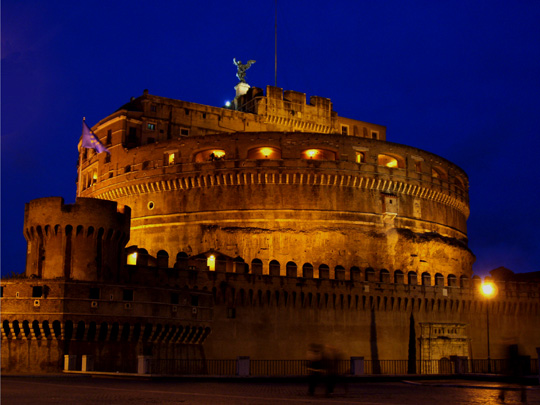
Here's the thing, though - did she jump from the outer edge and plunge five stories to her death? Or, did she jump from the interior side of the top floor - thus, only falling a mere two stories to the third story rooftop courtyard? (See the Castel Sant'Angelo pictured at the right.)
Now, if she landed in the courtyard - or the fourth floor balcony, for that matter - she likely survived. Did she get away? Did she spend the rest of her life on the run? Was she taken into custody for murdering Scarpia? What would prison have been like for the Prima Donna?
You see what I'm saying? There are unanswered questions. I'm not the only one who thinks like this, am I? [insert awkward silence here]
There is another of Puccini's operas that has recently been given a sequel ... or, is it a prequel of sorts? Hmmmmmmm ...
If any of you have seen me on my daily commutes from Brooklyn into Manhattan, you've seen me intently, and ferociously, reading through this book. Yes, I was the guy on the train who you had to repeatedly say "Excuse me" to because I was so engrossed in this novel that I didn't hear you the first four times you asked.
Incidentally, I'd like to take this opportunity to publicly apologize to the lady with the screaming toddler. If you read this book, ma'am, you'd understand where my brain was when you needed to get off the train. Sorry.
The culprit causing my involuntary thoughtlessness - which, by the way, was being held in my hands via the white-knuckled death grip - was Butterfly's Child: A Novel.
Written by Angela Davis-Gardner and recently released in paperback, Butterfly's Child follows Benji Pinkerton, the son of Lt. B.F. Pinkerton and the geisha, Cio-Cio-San ... also known as: Madame Butterfly.
I don't want to give too much away about this artful, incisive and enthralling tale that, on its own legs, could prove to be a psychologically riveting opera. But, I will say this: Butterfly's Child offers an abundance of plot twists that leave you speechless - mouth agape.
Starting with what we see at the end of Puccini's opera - the death of Butterfly (see below) - this book truly envelopes you from the heart-wrenching outset when a 3-year-old Benji Pinkerton is extricated from his life in Nagasaki following the tragic event. Taken to the Pinkerton Family farm in Illinois, Benji's true identity is concealed, forcing him to live as a foreign-born orphan might ... relegated to a life as an outsider - not just in the community of Palm River, Illinois - but, even in his own family.
Here is a newspaper clipping as depicted in Butterfly's Child:
The truth about Benji's identity eventually surfaces in Palm River. When it does, it shatters an already fragile family and sends Benji on a vision quest from Illinois to the Japanese settlements in Denver and San Francisco ... then, across the Pacific to Nagasaki, where he uncovers the shocking, core-rattling truth surrounding the death of the geisha called Cio-Cio ... Butterfly.
If you are looking for superb page-turner to take with you to the park this spring, you must pick up Butterfly's Child: A Novel - Trust me, Friends: you'll be so very glad you did.
As a teaser, here is Patricia Racette singing the tragic finale of Puccini's Madama Butterfly:
For example: when Tosca realizes that the gunshot, which was meant to be fake, actually kills her beloved Cavaradossi she dramatically runs to the edge of the Castel Sant'Angelo to get away from the guards. She then shrieks "O Scarpia, avanti a Dio!" and jumps. We've all seen it ... and if you haven't, *shame* on you.
Here's the thing, though - did she jump from the outer edge and plunge five stories to her death? Or, did she jump from the interior side of the top floor - thus, only falling a mere two stories to the third story rooftop courtyard? (See the Castel Sant'Angelo pictured at the right.)
Now, if she landed in the courtyard - or the fourth floor balcony, for that matter - she likely survived. Did she get away? Did she spend the rest of her life on the run? Was she taken into custody for murdering Scarpia? What would prison have been like for the Prima Donna?
You see what I'm saying? There are unanswered questions. I'm not the only one who thinks like this, am I? [insert awkward silence here]
There is another of Puccini's operas that has recently been given a sequel ... or, is it a prequel of sorts? Hmmmmmmm ...
If any of you have seen me on my daily commutes from Brooklyn into Manhattan, you've seen me intently, and ferociously, reading through this book. Yes, I was the guy on the train who you had to repeatedly say "Excuse me" to because I was so engrossed in this novel that I didn't hear you the first four times you asked.
Incidentally, I'd like to take this opportunity to publicly apologize to the lady with the screaming toddler. If you read this book, ma'am, you'd understand where my brain was when you needed to get off the train. Sorry.
The culprit causing my involuntary thoughtlessness - which, by the way, was being held in my hands via the white-knuckled death grip - was Butterfly's Child: A Novel.
Written by Angela Davis-Gardner and recently released in paperback, Butterfly's Child follows Benji Pinkerton, the son of Lt. B.F. Pinkerton and the geisha, Cio-Cio-San ... also known as: Madame Butterfly.
I don't want to give too much away about this artful, incisive and enthralling tale that, on its own legs, could prove to be a psychologically riveting opera. But, I will say this: Butterfly's Child offers an abundance of plot twists that leave you speechless - mouth agape.
Starting with what we see at the end of Puccini's opera - the death of Butterfly (see below) - this book truly envelopes you from the heart-wrenching outset when a 3-year-old Benji Pinkerton is extricated from his life in Nagasaki following the tragic event. Taken to the Pinkerton Family farm in Illinois, Benji's true identity is concealed, forcing him to live as a foreign-born orphan might ... relegated to a life as an outsider - not just in the community of Palm River, Illinois - but, even in his own family.
Here is a newspaper clipping as depicted in Butterfly's Child:
Galena Gazette, June 1, 1895Welcome to life in the mid-west circa 1895.
Plum River, Illinois. There is much commotion and merry-making these days in our community as Lt. Frank Pinkerton (son of Elmer, who died last year) and his wife, Katherine, have settled in at the Pinkerton farm. As if the presence of the refined Mrs. Pinkerton - the daughter of Galena's late missionary pastor, the Reverence Timothy Lewis - were not excitement enough, this Christian couple has brought with them, to rear as nearly their own as possible, a Japanese orphan boy rescued from the lowly society of Nagasaky, Japan. In his sermon Sunday last, Pastor Marshall Pollock called upon his flock to excite in their breasts all the human compassion of which they are capable and to extend every possible kindness and instruction to this heathen child in our midst.
The truth about Benji's identity eventually surfaces in Palm River. When it does, it shatters an already fragile family and sends Benji on a vision quest from Illinois to the Japanese settlements in Denver and San Francisco ... then, across the Pacific to Nagasaki, where he uncovers the shocking, core-rattling truth surrounding the death of the geisha called Cio-Cio ... Butterfly.
If you are looking for superb page-turner to take with you to the park this spring, you must pick up Butterfly's Child: A Novel - Trust me, Friends: you'll be so very glad you did.
As a teaser, here is Patricia Racette singing the tragic finale of Puccini's Madama Butterfly:
Thursday, April 19, 2012
Heiress Huguette Clark: SOLD! Her jewels fetch a handsome sum
Time for some more copper heiress news... oh, yes - it's time. As we know, since copper heiress and recluse Huguette Clark's death at 104, much ado has been made regarding her estate.
Last month, we reported that Huguette Clark's massive real estate holdings at 907 Fifth Avenue were hoisted onto the market. Fetching a possible $55 million, the three apartments figure out to be some 17,000 square feet of prime Manhattan real estate. Although Clark had not been living in the apartments, they remained fully furnished with furniture, priceless musical instruments, paintings by the likes of Monet and van Gogh plus, of course, Clarks huge collection of French and Japanese dolls.
Clark spent the last 20 years of her life in a secluded hospital room - admitted under an alias. During her absence though, the apartments were meticulously maintained by Clark's staff - many of whose families had served Clark and/or her mother Anna for generations. Some of the staff that maintains Bellosguardo, her seaside mansion in Santa Barbara, California, say they had never saw the heiress. Even during her last visits to Bellosguardo, only a select few members of her staff were allowed to see her. Others were kept away.
Well - according to my new best friend, Bill Dedman over at MSNBC, it appears that there are only 2 apartments left for the bidding:
Again, my friend Bill Dedman reports:
Check out the slideshow at MSNBC.com for a look at the jewels and their final sale prices.
Simply stunning. More to come, I'm sure.
Last month, we reported that Huguette Clark's massive real estate holdings at 907 Fifth Avenue were hoisted onto the market. Fetching a possible $55 million, the three apartments figure out to be some 17,000 square feet of prime Manhattan real estate. Although Clark had not been living in the apartments, they remained fully furnished with furniture, priceless musical instruments, paintings by the likes of Monet and van Gogh plus, of course, Clarks huge collection of French and Japanese dolls.
Clark spent the last 20 years of her life in a secluded hospital room - admitted under an alias. During her absence though, the apartments were meticulously maintained by Clark's staff - many of whose families had served Clark and/or her mother Anna for generations. Some of the staff that maintains Bellosguardo, her seaside mansion in Santa Barbara, California, say they had never saw the heiress. Even during her last visits to Bellosguardo, only a select few members of her staff were allowed to see her. Others were kept away.
Well - according to my new best friend, Bill Dedman over at MSNBC, it appears that there are only 2 apartments left for the bidding:
One of her three mysterious apartments on New York's Fifth Avenue found a buyer soon after they hit the market in March. The top-floor apartment, listed at $24 million, sold in less than a month for an undisclosed price. The two others remain on the market, at $19 million and $12 million. Each apartment has about 5,000 square feet of space. Also on the market: her country home in New Canaan, Conn., at $19.8 million.I also brought to your attention, Chiclets - that the real estate holdings aren't the only items belonging to Huguette Clark that were going on sale. Christie's announced the sale of millions of dollars of jewelry discovered in Huguette Clark's bank vault. The jewels, which were locked away for more than seven decades, went on Christie's New York auction block this last Tuesday.
Again, my friend Bill Dedman reports:
Hundreds of people filed through Christie's at Rockefeller Center to see her jewels over the weekend.Original estimations for the Clark's bedazzled items, $8.5 million to $12 million.
The highlight was a rare 9-carat purplish-pink diamond ring, with a pre-sale estimate of $6 million to $8 million.
"Four million dollars," started the elegant auctioneer, Rahul Kadakia. "Seven point five million dollars?" Kadakia added, hearing a bid. "All right, why waste time."
It was hammered home at $14 million, plus commission, for a total outlay of $15,762,500. The buyer of the "Clark pink" was identified as Brett Stettner of Stettner Investment Diamonds.
The pace was set with the first two items, onyx photo frames estimated at about $6,000. They each sold for $60,000. A pair of art deco bracelets sold for $90,000 and $480,000.
The total for all Clark items, with commissions, was $20.8 million.
Check out the slideshow at MSNBC.com for a look at the jewels and their final sale prices.
Simply stunning. More to come, I'm sure.
Thursday, April 12, 2012
2012 Richard Tucker Award announced
A hearty congratulations to soprano Ailyn Pérez who is the recipient of the 2012 Richard Tucker Award!
What follows is information that was provided to Yours Truly regarding the win.
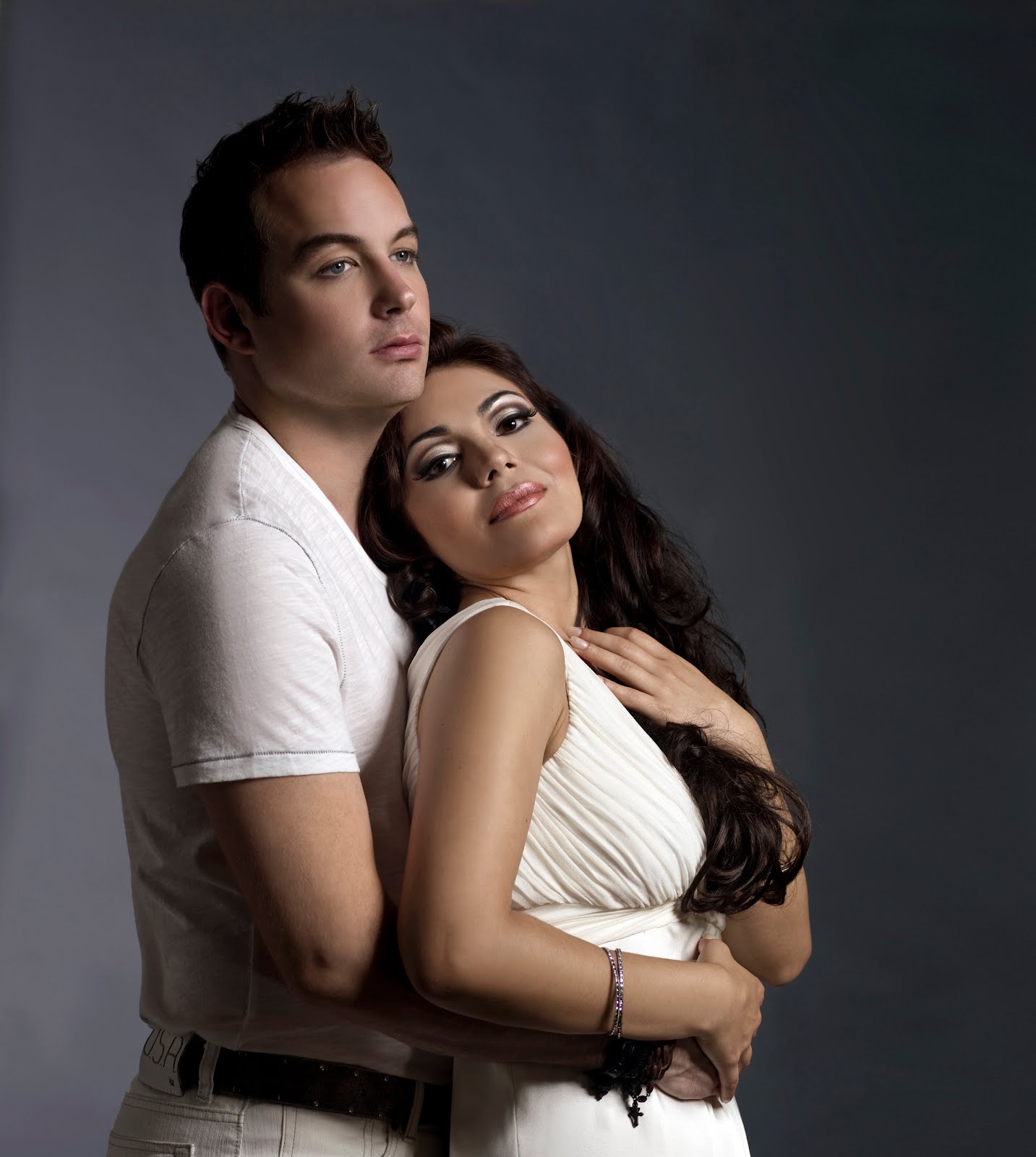
The Richard Tucker Music Foundation is pleased to announce that lyric soprano Ailyn Pérez is the winner of the 2012 Richard Tucker Award. This prestigious prize, which has been referred to as “the Heisman Trophy of opera,” carries the foundation’s most substantial cash award, of $30,000, and is conferred annually on an American opera singer at the threshold of a major international career. Previous winners include such luminaries of the opera world as Renée Fleming, Deborah Voigt, David Daniels, Joyce DiDonato, Lawrence Brownlee and Angela Meade. The 2009 Richard Tucker Award went to Pérez’s husband and frequent collaborator, tenor Stephen Costello, so her award renders the couple dubbed “America’s fastest-rising husband-and-wife opera stars” (Associated Press) the first to have two Richard Tucker Awards on the mantelpiece – one for each. Furthermore, Pérez is the first Hispanic singer to receive the award in its 34-year history.
Born in Chicago, Illinios to first-generation Mexican immigrants, Ms. Pérez earned degrees in vocal performance from Indiana University and Philadelphia’s Academy of Vocal Arts, where she met her now husband, Stephen Costello.
Her recent highlights include debuts at the Deutsche Staatsoper Berlin, Vienna State Opera, and Milan’s Teatro alla Scala; the title role of Gounod’s Roméo et Juliette for Opera Company of Philadelphia opposite Mr. Costello, and Marguerite in Mr. Costello's Faust at San Diego Opera, Santa Fe Opera, and Hamburg State Opera; Zerlina in Don Giovanni with the Dallas Opera, Countess Almaviva in The Marriage of Figaro at the Ravinia Festival, and Pamina in Die Zauberflöte with the Deutsche Staatsoper; the title role in Massenet’s Manon for Palau de les Arts in Valencia; Puccini’s Mimì at Cincinnati Opera; and her role debut as Leila in Bizet’s Pearl Fishers with the Teatro Municipal in Santiago, Chile.
In the coming months, you can catch her starring opposite Mr. Costello in three leading roles: Mimì in Puccini’s La bohème at Los Angeles Opera; Violetta – as whom she proved “ideal” (Observer) and “an unalloyed triumph” (Guardian) at London’s Royal Opera House – in Verdi’s La traviata at Cincinnati Opera; and Suzel in Mascagni’s L’amico Fritz at the Moscow State Philharmonic Society.
Mrs. Costello's Ms. Pérez’s high-profile gala appearances include collaborations with Plácido Domingo and Jose Carreras.
Barry Tucker, President of the Richard Tucker Music Foundation, said:
Do any of you have the same quizzical look on your face as I do?
Wow. I hope Stephen Costello sends a huge muffin basket over to the Tucker Foundation for all of the press he's getting surrounding his wife's 2012 Richard Tucker Award win.
Anyway, in addition toMrs. Costello Ms. Pérez, the Foundation also announced that nine other young American artists have been awarded study and career grants. 2012 Richard Tucker Career Grants of $10,000 each go to soprano Jennifer Rowley, mezzo-sopranos Jennifer Johnson Cano and Jamie Barton, and baritone Nicholas Pallesen, all of whom have already won recognition in their advancing careers. 2011 Sara Tucker Study Grants of $5,000 apiece go to five young singers displaying great promise at the start of their professional careers: mezzo-sopranos J’nai Bridges and Margaret Mezzacappa, bass-baritone Brandon Cedel, baritone Mark Diamond, and bass Scott Conner.
All scoffing aside: sincere congratulations to Ms. Pérez - as well as the other winners. This is truly a fantastic honor for them.
What follows is information that was provided to Yours Truly regarding the win.
The Richard Tucker Music Foundation is pleased to announce that lyric soprano Ailyn Pérez is the winner of the 2012 Richard Tucker Award. This prestigious prize, which has been referred to as “the Heisman Trophy of opera,” carries the foundation’s most substantial cash award, of $30,000, and is conferred annually on an American opera singer at the threshold of a major international career. Previous winners include such luminaries of the opera world as Renée Fleming, Deborah Voigt, David Daniels, Joyce DiDonato, Lawrence Brownlee and Angela Meade. The 2009 Richard Tucker Award went to Pérez’s husband and frequent collaborator, tenor Stephen Costello, so her award renders the couple dubbed “America’s fastest-rising husband-and-wife opera stars” (Associated Press) the first to have two Richard Tucker Awards on the mantelpiece – one for each. Furthermore, Pérez is the first Hispanic singer to receive the award in its 34-year history.
Born in Chicago, Illinios to first-generation Mexican immigrants, Ms. Pérez earned degrees in vocal performance from Indiana University and Philadelphia’s Academy of Vocal Arts, where she met her now husband, Stephen Costello.
Her recent highlights include debuts at the Deutsche Staatsoper Berlin, Vienna State Opera, and Milan’s Teatro alla Scala; the title role of Gounod’s Roméo et Juliette for Opera Company of Philadelphia opposite Mr. Costello, and Marguerite in Mr. Costello's Faust at San Diego Opera, Santa Fe Opera, and Hamburg State Opera; Zerlina in Don Giovanni with the Dallas Opera, Countess Almaviva in The Marriage of Figaro at the Ravinia Festival, and Pamina in Die Zauberflöte with the Deutsche Staatsoper; the title role in Massenet’s Manon for Palau de les Arts in Valencia; Puccini’s Mimì at Cincinnati Opera; and her role debut as Leila in Bizet’s Pearl Fishers with the Teatro Municipal in Santiago, Chile.
![]() |
| The Costellos for LA Opera's La Boheme - by Adam Leigh-Manuell |
Barry Tucker, President of the Richard Tucker Music Foundation, said:
"We are thrilled to be giving the Richard Tucker Award to Ailyn Pérez, a wonderful young soprano who sings with incredible beauty and heart. I first heard Ailyn singing La traviata at our auditions and was really impressed and moved, and I got to know her much better when Stephen Costello, her husband, won the Richard Tucker Award three years ago. I told him then how lucky he was to have such a lovely and talented wife, and we are so happy to be able to recognize her in her own right today. I know she will make the Richard Tucker Foundation proud.”_________________________________
Do any of you have the same quizzical look on your face as I do?
Wow. I hope Stephen Costello sends a huge muffin basket over to the Tucker Foundation for all of the press he's getting surrounding his wife's 2012 Richard Tucker Award win.
Anyway, in addition to
All scoffing aside: sincere congratulations to Ms. Pérez - as well as the other winners. This is truly a fantastic honor for them.
Monday, April 9, 2012
In Memoriam: Mike Wallace 1918-2012
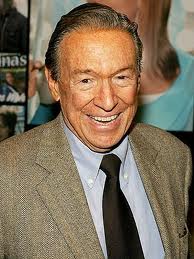
Often called the Grand Inquisitor of interviewers, Mike Wallace, who once declared there was "no such thing as an indiscreet question," died on Saturday at the age of 93.
In almost 40 years on the ground-breaking investigative journalism program "60 Minutes," he worked on some 800 reports, won 21 Emmys and developed a relentless on-air style that was characterized as interrogation rather than interview. In fact, during once such interrogation of a stage and screen legend, Mike Wallace became the only interviewer to cause the diva to cry. That legend: Barbra Streisand.
Wallace interviewed every U.S. president since John F. Kennedy - with the exception of George W. Bush -- and dozens of other world leaders. He also interviewed everyone from Malcolm X to Janis Joplin, Martin Luther King Jr., Johnny Carson and Playboy founder Hugh Hefner.
But, after zillions of interviews, which was Mike Wallace's favorite? Surprisingly enough, Morley Safer wrote in a tribute on CBSNews.com:
Mike Wallace, rest peacefully.
In almost 40 years on the ground-breaking investigative journalism program "60 Minutes," he worked on some 800 reports, won 21 Emmys and developed a relentless on-air style that was characterized as interrogation rather than interview. In fact, during once such interrogation of a stage and screen legend, Mike Wallace became the only interviewer to cause the diva to cry. That legend: Barbra Streisand.
Wallace interviewed every U.S. president since John F. Kennedy - with the exception of George W. Bush -- and dozens of other world leaders. He also interviewed everyone from Malcolm X to Janis Joplin, Martin Luther King Jr., Johnny Carson and Playboy founder Hugh Hefner.
But, after zillions of interviews, which was Mike Wallace's favorite? Surprisingly enough, Morley Safer wrote in a tribute on CBSNews.com:
"It's strange, but for such a tough guy, Mike's all-time favorite interview was the one with [legendary], pianist Vladimir Horowitz. The two of them, forces of nature both: Sly, manic, egos rampant. For Mike -- a red, white and blue kind of guy -- Horowitz played 'The Stars and Stripes Forever.' It almost brought tears to the toughest guy on television."One of my favorite Mike Wallace interviews is one that he did with soprano Maria Callas in her Paris apartment. He aggressively goes after Callas in a way that 5 or 10 years prior to this interview, he would not have gotten away with. Callas would have had his head on a platter. But, in 1973, Callas was a different person ...
Mike Wallace, rest peacefully.
Wednesday, April 4, 2012
Hojotoho! Wagner's Dream
It's sometimes hard to truly figure out who is the real star the Met Opera's $16 million Ring Cycle. Is it one of the many operatic stars that grace the productions? I mean, when you have Deborah Voigt (Brünnhilde), Stephanie Blythe (Fricka), Jonas Kaufmann (Siegmund), Bryn Terfel (Wotan), Eric Owens (Alberich), Waltraud Meier (Waltraute) and Jay Hunter Morris (Siegfried) - only to name a few - it's hard to pick out the true star of that group.
Perhaps we don't have to.
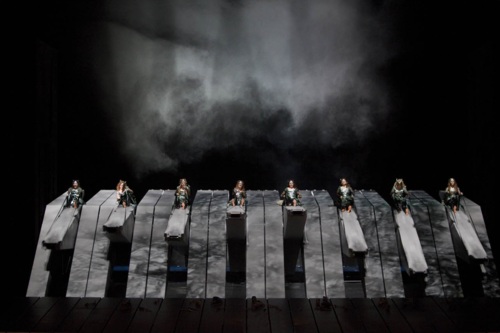
It seems that ever since it was reported that the Met Opera had to reinforce their stage with 65-foot steel girders (a process that involved permanently placing thousands of pounds of steel under the stage) that it was indeed "the machine" that would be the true star of these productions. By "the machine" I mean the 45 ton set of 24 moveable planks on which the four installments of the Cycle - Das Rheingold, Die Walkure, Siegfried and Gotterdammerung - are staged. Since it it first debuted in the 2010-2011 season, the gigantic, creaky, yet technologically advanced, machine has been as temperamental as a pushy diva. The machine has suffered technical misfires and has been blamed for incredibly distracting noises.
Yes, we've heard countless stories about "the machine". Just about a year ago, the blog Superconductor reported on two incidents:
And now, you will be able to see the behind-the-scenes action in a new Susan Froemke directed documentary. Froemke followed the Met Opera as it worked on the production over the last four years, documenting the creative processes driving the show, the backstage struggles with the machine, and more.
As we know, this is not Froemke's first time at the classical rodeo. Not only did she create films featuring subjects like pianist Vladimir Horowitz and conductor Seiji Ozawa (co-produced with Met general manager Peter Gelb, at the time the head of Sony Classical) but, she also directed the 2009 documentary, The Audition, which went backstage at the Met's National Council Auditions.
Wagner's Dream will screen at the TriBeCa Film Festival in New York, which runs from April 18 to April 29. The film will also be in theaters in May, in conjunction with the live HD screenings of the production itself.
As a teaser, here is the trailer for Froemke's documentary:
Perhaps we don't have to.
It seems that ever since it was reported that the Met Opera had to reinforce their stage with 65-foot steel girders (a process that involved permanently placing thousands of pounds of steel under the stage) that it was indeed "the machine" that would be the true star of these productions. By "the machine" I mean the 45 ton set of 24 moveable planks on which the four installments of the Cycle - Das Rheingold, Die Walkure, Siegfried and Gotterdammerung - are staged. Since it it first debuted in the 2010-2011 season, the gigantic, creaky, yet technologically advanced, machine has been as temperamental as a pushy diva. The machine has suffered technical misfires and has been blamed for incredibly distracting noises.
Yes, we've heard countless stories about "the machine". Just about a year ago, the blog Superconductor reported on two incidents:
According to several reports on Twitter, Eve Gigliotti, singing the role of Siegrune, fell off the machine, landing in the space between the stage apron underneath the still-moving planks. The audience gasped, and the scene continued with seven Valkyries until Ms. Gigliotti returned to the stage, to a wave of audience applause.One of the earliest incidents to be reported was reported by the NY Times in September of 2010:
Ms. Gigliotti did not take her curtain call at the end of the opera. However, soprano Deborah Voigt, singing the role of Brunnhilde in the production, reported on her Twitter (@debvoigt) that the singer was OK. On her own Twitter account (@evegigliotti) Ms. Gigliotti said that she was "home and resting."
This is the second accident in this production involving the set. On opening night, Ms. Voigt was supposed to clamber up the set and hug her father, Wotan (Bryn Terfel) atop the contraption. But she slipped on the set before her opening "Hojotohos" and slid about two feet down to the apron. She picked herself up and sang an admirable set of battle-cries, continuing the performance without missing a beat.
The Rhinemaiden descended by a cable to the floor of the Metropolitan Opera stage. She extended her body just in front of a hollow beneath part of the set for Wagner’s Rheingold. Slowly, inexorably, the edge of a 45-ton structure tilted down toward her.Would "the machine" truly be what Wagner would have wanted to be the star of his 16+ hours of music - as opposed to the stars that sing his music? Well, regardless, the Met Opera set out to bring Wagner's dream of a perfect Ring to the stage.
“Get her underneath,” a stagehand said urgently into a walkie-talkie. “Manny, get her underneath.”
“Now!” he added, his voice rising in panic.
The Rhinemaiden, a.k.a. Jennifer Johnson, was soon dragged to safety, eliminating the danger of a squashed mezzo-soprano. But the scary moment — really just a bump to be ironed out in early rehearsals, in the eyes of the producers — was a reminder of the risks and hurdles involved in mounting what the Met calls the most complicated production ever put on its stage: a new Wagner “Ring” cycle that involves a leviathan set, scenery almost entirely based on intricate computerized projections and a few age-old theatrical techniques.
It is just the sort of thing, its creators say, that Wagner would have wanted: the most advanced technology in service of his opera.
And now, you will be able to see the behind-the-scenes action in a new Susan Froemke directed documentary. Froemke followed the Met Opera as it worked on the production over the last four years, documenting the creative processes driving the show, the backstage struggles with the machine, and more.
As we know, this is not Froemke's first time at the classical rodeo. Not only did she create films featuring subjects like pianist Vladimir Horowitz and conductor Seiji Ozawa (co-produced with Met general manager Peter Gelb, at the time the head of Sony Classical) but, she also directed the 2009 documentary, The Audition, which went backstage at the Met's National Council Auditions.
Wagner's Dream will screen at the TriBeCa Film Festival in New York, which runs from April 18 to April 29. The film will also be in theaters in May, in conjunction with the live HD screenings of the production itself.
As a teaser, here is the trailer for Froemke's documentary:
Monday, April 2, 2012
Can singing in a choral group make us more successful?
![]() |
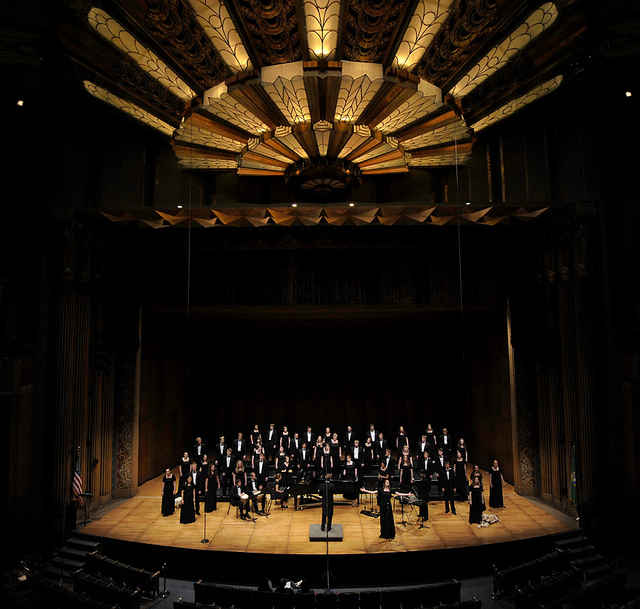
| My alma mater: The Whitworth Choir |
Chorus America has published some research which shows that kids who sing in a choral group are more creative, have more self-esteem, have better memory, and watch less TV than kids who aren't in choral groups.
And, kids aren't the only ones who reap the benefits ...
The study found that an estimated 42.6 million Americans regularly sing in choral groups today. More than 1 in 5 households have at least one singing family member, making choral singing the most popular form of participation in the performing arts for both adults and children.
That’s stellar news because the study also found that singing in one of the 270,000 choruses in the U.S., such as a community chorus or a school or church choir, is strongly correlated with qualities that are associated with success throughout life. Greater civic involvement, discipline, and teamwork are just a few of the attributes fostered by singing with a choral group.
As it turns out, choral singers are an unusually engaged group of citizens. Choral singers are much more likely to volunteer in their communities and to contribute money to philanthropic causes. They’re far more likely to take on leadership roles, too, and to participate in the political process. According to the study, 96% of adult choral singers who are eligible voters vote in national and local elections—compared to 70% of the general public who are voters. And an overwhelming number of choral singers also report that singing in a choral group has helped them become better team members in other areas of their lives.
Given the fact that choral singers are responsible and socially conscious citizens, it stands to reason that the choral groups to which they belong are also strong contributors to society — and, in ways that transcend the choral arts themselves. Many choral groups routinely use their concerts as fundraising vehicles for deserving community not-for-profit organizations. Additionally, many choral groups sponsor scholarships for deserving students of the arts - many of whom, because their craft is not held to the same high esteem that many sports are, find that scholarships to further their education are not as bountiful.
Here's a very interesting graph from Chorus America related to the success of choral kids:
So, when people at your school board, PTA or community board meeting are on their soap boxes about sports being the source of self-esteem, leadership and camaraderie ... take this study to them. Perhaps people will think twice before bringing the ax down on music education and choral music in our schools. And, perhaps continuing education institutions will consider making music scholarships more of a priority.
And, find a choral group - sing! You'll be better for it.
Subscribe to:
Posts (Atom)