Thursday, July 28, 2011

"I'll take: 'Things that never happen in the U.S.' for $1000, Alex"

We all know that there are certain absolutes in life.

I feel that one of these absolutes is that in our country, opera stars like Anna Netrebko and Erwin Schrott would not get the same paparazzi-star-treatment that we-Americans reserve for people who do nothing meaningful to further culture other than take up space on our televisions ... people like the Kardashians or those blockheads from Jersey Shore.

In Europe, things are a little different. Here is opera's "It Couple" arriving via convertible - that just so happened matched Erwin's new haircolor - for the opening night of Salzburg Festspiele.

Eat your heart our, Alex McCord -


And my personal favorite: 


I'm very thankful that Mr. Schrott left his "MC Hammer" pants at home ... too bad he didn't remember to do that here. OH! And, here too.

[Photos appear courtesy of OperaChic. Thanks, OC!]

Friday, July 22, 2011

A Review: Remembering JFK - 50th Anniversary Concert

Today, the eyes of all people are truly upon us - and our government ... at every level, must be as a city upon a hill - constructed and inhabited by men aware of their grave trust and their great responsibilities. For those to whom much is given, much is required. - President-Elect John F. Kennedy 1961
These words are the first words that come to life within a spectacular piece of music that was commissioned by the National Symphony Orchestra to commemorate the 50th Anniversary of President John F. Kennedy's inauguration.

Now, I don't have to remind you that I am truly am truly obsessed with news, politics and the like. I'm the guy who sets the DVR for pretty much any major news story that requires all day and/or all night coverage. I have to be totally honest, though ... specifically, I love a great news story that includes even the smallest amount of pomp and circumstance.

I can't help it - I'm Episcopalian. We love our pomp and circumstance.

If you take news, politics, pomp and circumstance and add to it a pinch of vintage '50s or '60 - I, my Friends, go completely bonkers. I mean over the moon. I mean wack-a-doodle.
obsession [uhb-sesh-uhn]: the domination of one's thoughts or feelings by a persistent idea, image, etc. the state of being obsessed. the act of obsessing.
Yep. That pretty much covers all of the bases.

Imagine my delight when I received in the mail, a copy of the National Symphony Orchestra's CD Remembering JFK - 50th Anniversary Concert ... then, imagine the degree to which my delight turned to utter wack-a-doodleness when Yours Truly finds out that there's not only a CD of this year's concert conducted by Maestro Christoph Eschenbach - Oh no, Friends ... hold on to your seats - there is also a CD containing excerpts from the Mutual Broadcasting radio broadcast of JFK's actual Inaugural Concert - January 19, 1961.

I. Know. I about choked on my lunch, too.

Now, to the piece of music I was discussing earlier - as I said, Remembering JFK (An American Elegy) was commissioned by the National Symphony Orchestra to commemorate the 50th Anniversary of President John F. Kennedy's inauguration. Written by Peter Lieberson, who was just a young lad when JFK was elected, Remembering JFK is certainly the cornerstone of the first disc in this stellar set.

Lieberson points out:
My generation took a certain kind of inspiration just in Kennedy's presence, in his words.
For his portrait of Kennedy, Lieberson drew on the inspiration of Kennedy's words by showcasing excerpts from three separate speeches, chronologically ordered. The first is from January 9, 1961 when then president-elect Kennedy addressed the General Court of the Commonwealth of Massachusetts. The second is from the January 20, 1961 Inaugural Address and the third is from June 10, 1963 when President Kennedy addressed the graduating class of American University. Again, Peter Lieberson:
There is an elegiac quality surrounding this inspirational figure, since in the end he was not able to accomplish so much of what he wanted. But there was also a practical element in his understanding of human nature that couples with the visionary. I chose speeches that reflect both.
The narration in these kinds of pieces can be tricky because one wants to hear the commanding authority of a president without an imitation of the man who spoke the words decades ago. In this case, the narration is provided to us by the very distinctive voice of Mr. Richard Dreyfuss - who does just that ... gives us the commanding authority without affectation.

Lieberson, who was born in 1946, grew up in a very artistic family. Igor Stravinsky and Leonard Bernstein were regular visitors to the Lieberson's Upper West Side, Manhattan home and certainly, the aura of Bernstein is evident from the very opening bars of the piece ... as are little flecks of Stravinsky.

Other pieces of note on this first disc in the set are George Gershwin's magnificently groovy Concerto in F, Leonard Bernstein's iconic Symphonic Dances from West Side Story and the 35 seconds long Fanfare for the Inauguration of John F. Kennedy also written by Bernstein.

Putting aside Mr. Americana, Aaron Copland, I can't imagine a better group of pieces to befittingly convey through music the delight, inspiration, encouragement, joy and true optimism that Kennedy's Inauguration brought to so many Americans.

The night before that inauguration 50 years ago, Howard Mitchell conducted the National Symphony Orchestra in an Inaugural Concert in honor of the president-elect. The second disc in this set brings highlights from that concert - including marvelously vintage radio commentary by reporters from Mutual Broadcasting. Just to hear the radio commentary describing every detail with precision and depth warms the heart of this ardent admirer of the simpler, classier and swanky-er times ... times when all of the arts were seen as an essential part of American identity.

Less than a month before his assassination, President Kennedy gave a speech in honor of the memory of poet Robert Frost. It outlined his vision of the challenge that the arts must pose for a strong and flourishing democracy. He said in part:
I see little of more importance to the future of our country and our civilization than full recognition of the place of the artist."
On this incredibly hot weekend in NYC, do yourself a huge favor get yourself a copy of this. Close the blinds. Turn the A/C just a little cooler. Pop it in the CD player - I recommend listening to disc #2 first, followed by disc #1.

Trust me when I say, you're sure to be inspired, enkindled, restored and to feel just a little cooler.

Thursday, July 14, 2011

NY City Opera: Now, AGMA Speaks

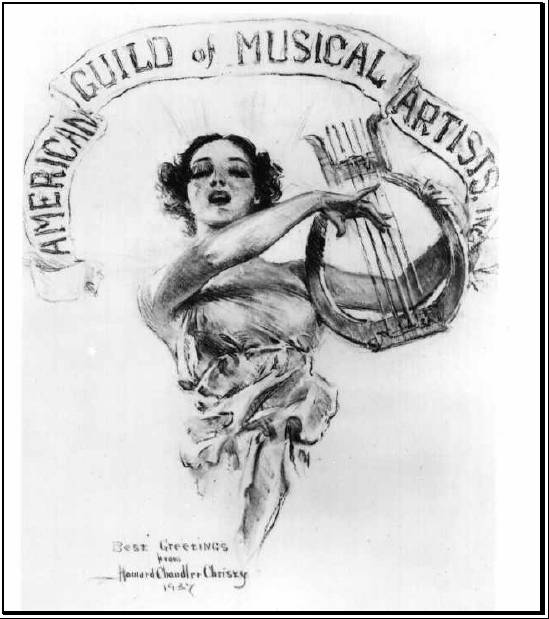
On Tuesday, George Steel gave his "season" announcement - and, while he was at it, fired shots at his critics and at the American Guild of Musical Artists (AGMA).

Now, it's AGMA's turn:
Subject: WORK FOR NYCO PROHIBITED
Date: Wed, 13 Jul 2011 12:43:01 -0400 (EDT)
From: [email protected]
To: [email protected]

AGMA, AFL-CIO
1430 Broadway
New York City 10018
[email protected]

Dear Members:

Yesterday, George Steel announced that you would be performing for NYCO in its next season, assuming that NYCO continues to exist. The AGMA Constitution, which AGMA will aggressively enforce in court, prohibits you from performing for City Opera in the event of a Guild picket line is in effect.

As you may be aware, the collective bargaining agreement between AGMA and New York City Opera expired in April. George Steel has, for all intents and purposes, proposed to eliminate all guaranteed employment for AGMA members, to cancel their health insurance, to eliminate the requirement for AGMA membership, to hire student and volunteer singers and to unilaterally extend the work day of principal artists, without any limitation. Although we are finally about to become engaged in negotiations for a successor agreement, given the proposals made by George Steel, it is unlikely in the extreme that a successor agreement will be successfully concluded quickly.

In any event, under federal labor law, the provisions of that expired contract must continue to be honored by NYCO until a successor agreement or an impasse is reached. One of the continuing provisions requires that AGMA receive a copy of, and consent to, any individual employment pursuant to a Standard Artists Agreement. We have not received a copy of any agreement purporting to cover your employment. Without regard to City Opera’s failure to tender a copy of that letter, AGMA is not prepared to approve any such contracts unless a current collective bargaining is in effect between AGMA and City Opera at the time of the performance.

If AGMA and City Opera fail to successfully conclude a collective bargaining agreement prior to the start of your contracted employment, AGMA will not sanction your performance of any services for City Opera.

Moreover, in the event that an impasse occurs in the negotiations, and an AGMA picket line exists at any venue in which City Opera is performing, the AGMA Constitution prohibits you from crossing that picket line.

While I am sure that you and your agent may find this advice distressing, I can not fail to remind you that our obligation is to preserve, to the extent possible, the protections of the collective bargaining agreement for the men and women who have given their careers to City Opera and who would, if George Steel succeeds in presenting non-union productions, be cast out on the street, unable to provide for their support and the welfare of their families.

We are certain that we can count on your support. Inasmuch as AGMA is obligated to do everything possible, in the event of a strike, to prevent George Steel from effectuating his destruction of City Opera, I also need to advise you that AGMA will impose fines on any member who crosses an AGMA picket line and will sue to collect those fines in the appropriate federal or state court.

We sincerely hope that these actions will not become necessary.

Cordially,

Alan S. Gordon

Tuesday, July 12, 2011

NY City Opera: Steel speaks

Today's "season" announcement from New York City Opera's George Steel has wrapped up. Judging from the live tweets during the event, no "breaking news" was delivered. (Don't you hate it when a leak from within your organization steals your thunder?)

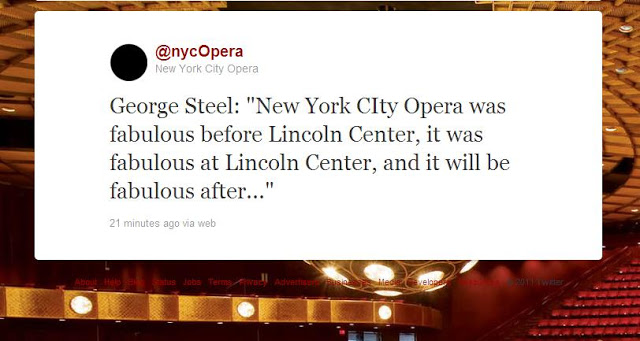
There was one interesting little tidbit though:


Buona fortuna, George. I have a feeling you're going to need it.

NY City Opera: Today is announcement day.

George Steel has just taken the podium to make his announcement regarding the 2011-2012 New York City Opera "season". And with that, I give you:

Monday, July 11, 2011

NY City Opera: The new "season" & a protest by 120 stars from the opera world. UPDATED

City Opera is bleeding.
Being as astute as you are, my Chickpeas - I'm sure you've all seen the announcements and subsequent media coverage of the NY City Opera "season" announcement. If not, here's a little recap from The New York Times:
Opera fans have been waiting for months to hear the company’s plans for next season, especially since its general manager and artistic director, George Steel, announced in May that City Opera would abandon its Lincoln Center home for undisclosed locations in New York. He said the move would save money and help the company survive financially, although many former singers and other opera-world figures denounced the decision...

... On Wednesday, some details were provided by a company official and a company member, both speaking on condition of anonymity because they were under orders not to disclose the information.
La Traviata and Prima Donna will be performed at the opera house at the Brooklyn Academy of Music. Prima Donna has already been performed in Manchester, England, and in Toronto. One of the people said La Traviata was being rented from the Glimmerglass Festival in Cooperstown, N.Y.

The festival’s managing director, Linda Jackson, said City Opera had asked about the production — which is by Jonathan Miller — but no contract had been signed.

The Gerald W. Lynch Theater at John Jay College will play host to
Così Fan Tutte, in a production directed by Christopher Alden, who directed Don Giovanni for the City Opera two seasons ago. Operas have been performed before at the Lynch Theater, which right now is the scene of a run of
Peter Brook’s adaptation of
The Magic Flute for the Lincoln Center Festival.

Finally, a Baroque opera — by Telemann, according to a company member — will be performed at the 600-seat theater at the Museo del Barrio on Fifth Avenue and 104th Street. City Opera officials declined to comment.
Well, ok - City Opera "officials" did decline to comment - but, a former official certainly made his opinion known.

As you no doubt read here, former Maestro and General Director of City Opera - Julius Rudel - has been outspoken about his thoughts on where the company is headed:
I cannot sit by and watch as the legacy that was built by a company, if not a family, of talented, dedicated people is cast aside...

... Once before, in 1956, City Opera faced the threat of bankruptcy, but instead of retrenching and cutting, the board boldly moved forward, securing the financing we needed to stabilize the company and then grow. The current board must reconsider its decision and demonstrate the commitment and vision its predecessors had.

If the board and management of City Opera cannot finance, produce and support full seasons of new works and standard operas in interesting productions with first-rate casts as we once did, they should be replaced, so that 68 years from now no one will wonder what ever became of City Opera.
As George Steel was readying his "season" announcement, it seems that he contacted Maestro Rudel to try to get him on board with the plans. (Evidently, Mr. Steel doesn't realize that reading A Liberal's Libretto would have saved him a lot of time.)

Again, from The New York Times:
On Wednesday, Mr. Rudel said Mr. Steel had called and asked him to appear at the season announcement and endorse his plans.

“After I recovered, I said, ‘Have you read my piece?,’ ” Mr. Rudel said. “I don’t know that he answered. I said I could never do that, because it’s all wrong. It’s all false. He said, ‘You’ll see, we have wonderful things coming up.’ I said, ‘I cannot possibly endorse this. For me it’s the end of the opera company.’ ”

Mr. Rudel then quoted Mr. Steel as saying that his absence would hurt the company’s recovery effort. “That was his attempt to get me there, putting a little guilt on my shoulders,” Mr. Rudel said. “I certainly don’t feel guilty.”
It didn't stop there, Ladies and Gents. Oh, no it did not.

Soprano Catherine Malfitano
Soprano and stage director Catherine Malfitano, who made her NY City Opera debut as Mimi in 1974, has penned a letter to City Opera in protest of the current plan. Not only did she pen the thing - she got 120 singers, directors, composers etc. to sign it with her. People like June Anderson, Jane Bunnell, Tito Capobianco, José Carreras, Frank Corsaro, Phyllis Curtin, Justino Díaz, Joyce DiDonato, Plácido Domingo, Carlisle Floyd, Jake Heggie, John Mauceri, Sherrill Milnes, Jan Opalach, Samuel Ramey, Regina Resnik, Hal Prince and Frederica von Stade.
The letter, which was released to The New York Times on Thursday, calls on the company’s board and management to reconsider the move from its longtime home at the David H. Koch Theater (formerly the New York State Theater). “To lose City Opera as a vital part of the Lincoln Center family would be felt as a personal loss to each and every one of us as well as to this great city,” the letter says, “and we find it unnecessary and unacceptable.”

The letter accuses the management of “the dismembering of City Opera, piece by piece, person by person.” In an interview Ms. Malfitano said the reference was to the loss of key officials in recent years as well as the sharp cutback in orchestra and chorus involvement in a shrunken season.

“An opera company is a team, a cohesive family of soloists, chorus, orchestra and backstage and administrative personnel, which brings with it a shared point of view, a richness of context, ensemble values and a nest for nurturing young artists,” the letter says. “If City Opera is transformed into a small ad hoc presenting organization forced to deploy pickup orchestras, choruses and soloists, it can never again achieve these things and therefore cannot retain its identity or its impact.” ...

... “A thorough and honest examination of the company’s leadership and artistic profile is what is called for,” the letter says. The signatories offer to give advice to the board: “We know opera, and we want to help.” ...

... Ms. Malfitano said she felt encouraged to circulate the letter after a recent Op-Ed article in The Times by Julius Rudel ... who took issue with the company’s plans. She also cited the singer Joyce Castle, who had resigned from City Opera’s board in protest and who also signed the letter.
George Steel declined to comment on the letter, as did Charles Wall, the board's Chairman. But, company spokeswoman, Maggie McKeon, issued a brief statement:
“Our decision to leave Lincoln Center was not entered into lightly,” she said. “Rather, it was born of very real financial necessity.” Ms. McKeon said the company’s new model “not only reverses a decade-long trend of debilitating deficits, but — equally important — provides tremendous artistic opportunity and a clear artistic vision for moving forward.”
"Like sands through the hour-glass ..."

**UPDATE**

And just when you thought the plot couldn't get any juicier...

According to our dear friend La Cieca at parterre.com, the following email was sent by AGMA (American Guild of Musical Artists) to it's members:
Subject: NYCO

To: NYCO Chorus & Production Staff

As you know, there is a joint AGMA/802 press conference/rally across the street from the Guggenheim Museum at noon tomorrow, just prior to George Steel’s formal announcement of his proposed schedule. His lawyers have now sent us NYCO’s ‘proposals’ for the AGMA contract, and I have included a list of them below. Although they are destructive in the extreme, we continue to pursue action to save NYCO in all available forums, and it is obviously important for as many of you as is possible to attend tomorrow’s press conference.

NYCO PROPOSALS

* Eliminate all health insurance.
* Eliminate ‘contract year’.
* Eliminate all employment guarantees.
* Eliminate weekly artists.
* All employment to be on a per-performance basis.
* Eliminate re-engagement rights.
* Eliminate tenure.
* Eliminate minimum staffing provisions.
* Eliminate paid time off.
* Eliminate vacation pay.
* Eliminate travel time.
* Eliminate all references to New York State Theater.
* Eliminate releases and leaves of absence.
* Freeze severance pay. Payable only to people who resign now.
* Allow non-AGMA singers, not covered by contract.
* Eliminate dancers from contract.
* Eliminate production staff numbers and guarantees.
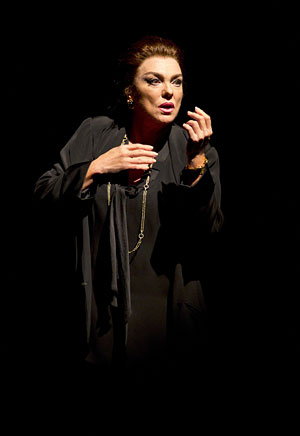
Clearly, Chiclets ... if I were George Steel - or a member of the Board of Directors, for that matter - and this were an opera, I think I'd begin to feel a little bit like this lady right here:


Friday, July 8, 2011

A Friday Finale: Tyne Daly as Maria Callas in 'MASTER CLASS'

MASTER CLASS Marquee. Courtesy of Walter McBride
Last night, the first big production of the new Broadway season opened. It was, of course, a revival of Terrence McNally's MASTER CLASS starring Tyne Daly as La Divina, Maria Callas.

Directed by Stephen Wadsworth, this production by the Manhattan Theatre Club also stars Sierra Boggess (recently of Andrew Lloyd Webber's musical Love Never Dies) as Sharon Graham, Alexandra Silber as Sophie De Palma, and Garrett Sorenson as Anthony Candolino.

Tyne Daly as "La Divina" Maria Callas (AP)
The reviews are flooding in and I thought I should bring you some highlights for today's A Friday Finale:

The New York Times' Ben Brantley says in part:
MASTER CLASS is not, by even a generous reckoning, a very good play, though it can be an entertaining one. Mr. McNally is an opera buff who here mixed a passionate fan's knowledge of myth, gossip and music into one pulpy, Broadway-ripe package. Yet Ms. Daly transforms that script into one of the most haunting portraits I've seen of life after stardom.
Jeremy Gerard of Bloomberg says:
Terrence McNally's funny, reverential and wholly engrossing MASTER CLASS brings us all too briefly into the distinctive orbit of Maria Callas...And as the play recreates a master class in singing, so Tyne Daly as the singer offers a master class in technique to inspire any acting student or colleague.
David Rooney writes for The Hollywood Reporter:
It should be no surprise that someone with six Emmys and a Tony is an accomplished actor, but Tyne Daly is doing something extraordinary in MASTER CLASS...Bottom Line: Tyne Daly's mercurial performance gives equal exposure to her character's formidable outer shell and to the corrosive solitude within.
The Philadelphia Inquirer's Howard Shapiro says:
...the revival's pensive quality gives Daly room to reflect, to stunning result. She delivers more without moving a single facial muscle than many actors say with a wide range of emotions.
Here are some highlights courtesy of BroadwayWorld.com:


Wednesday, July 6, 2011

Apparently, the fat lady has sung at Opera Australia - and she's not coming back

"Hojotoho!"
I have to admit to you, my Friends ... my most recent post left me spent. How in the world can you post something after that - I mean, is there anything worthy of bumping Huguette Clark off the top spot?

Well, my frustration has gotten the best of me and if I don't let it out here, I'm likely to explode. And trust me when I say - no one wants to see me to that. It ain't pretty.

From The Sydney Morning Herald:
The fat lady has sung. And if Lyndon Terracini continues to get his way, she won't get an encore until she at least shifts some weight.

Lest the man charged with overseeing the future of opera in Australia be accused of sexism, he is quick to point out that his shape-up-or-ship-out message applies to all performers, regardless of gender.

"If you're seeing a couple making out and one of them is obese, who wants to watch that?" he says with a theatrical grimace. "It's obscene. You just think, 'Jeez, for Chrissakes, don't let the children see that'."

Terracini's views on how performers should look will outrage some and surprise others who still associate opera with super-sized sopranos in body armour and viking horns. But for the artistic director of Opera Australia, who next month unveils the program for his first season, that's exactly the point.

If casting "triple threats" who can sing, act and look good helps spark an interest among people who think opera is only for the old and rich, then he makes no apologies for upping the unemployment rate of overweight singers.

"You go to a movie and you see people who look exactly right for that role," he says. "They're consummate actors and they're completely involved in what they are doing, so their performance is totally believable.

"That's what I'd like in opera: for people to be fabulous singers, look wonderful and be completely and totally absorbed in their character. If you can't get off the seat, if you've got to sit on a rock all night, who believes that?"
Are we still going around and around about this, people? Come on. If you're going to cast opera on film - then, fine ... this Lyndon Terracini character can have his way.

The Metropolitan Opera - in all it's largeness.
But, I ask you: who wants to go and sit at the Met (pictured) and watch a tooth pick, who you can barely see, give her best attempted Meryl Streep impersonation with a voice the size of Jackie Evancho? That is not opera.

As I have said here before - it appears that the fundamentals of the opera world are changing. Opera is a big art form. An art form which, for the most part, requires big voices, big gestures and big personalities. It has always been centered around the voice and around making a sound big enough to cut over the orchestra and to fill a house without amplification. Anyone who has done it knows that this is a tall order - and, generally speaking, it comes easiest to a person of a more substantial build. Like it or not, there is truth to it.

When did we decide to mold our art form into looking like everything else that's out there? When did we decide that Hollywood's ideal should be our ideal, too?

I'm not advocating that every opera singer should run out and become morbidly overweight. But, becoming so obsessed with your size that you affect the core instrument that is needed to make the sounds that are the bedrock of what makes opera great, isn't the answer either.

"Hello? Mr. Terracini? Pro-ana called and is holding on line-one for you."

Indeed, it now seems that opera is being down-sized and shoved into a small, very confining box ... well, movie screen. The metamorphosis from operatic-grandiosity to Hollywood-fabulosity will begin to take it's toll on our art form. Sooner or later.

Leontyne Price as Butterfly
Now, perhaps a little sanity from The Sydney Morning Herald article:
The Herald's classical music critic, Peter McCallum, says because of the long lead time for opera seasons, it's too early to assess Terracini's performance.

"I don't think we've seen his indi-vidual stamp yet," he says. "Yes, there's Boheme, but we've seen good Bohemes before, notably the Baz Luhrmann one."

McCallum welcomes efforts to engage young people but says high ticket prices remain a barrier. Introducing broader discounts - for students, or people from disadvantaged areas, for example - could help.

As for the artistic director's views on how singers should look, McCallum warns Terracini is on dangerous ground. "It's really hard to cast opera - to get the voices people want and people who look great as well," he says.

"There are plenty of fantastic Asian singers around and we don't mind casting them in the big roles of Italian lovers or
La Boheme, and there are some fantastic female black singers who have played Madama Butterfly. There's got to be a suspension of disbelief … after all, what is a Valkyrie supposed to look like?"
Related Posts Plugin for WordPress, Blogger...